Signature: 9tadFN3Q43CNfUXX0ier+fKrqJH78Ta+EQlcW4HUJGRqMd252GYRF6bOv40euy2lGRklmD1rBf06p4c7Hjj7uFPAxAxbP7MFYQysVD3CTkWa23Ff/mhJN5rAl3RjZ1oT/QsctSTfKi6uEF72PHCC59f6DuVI9sho9MnwOKhV45E3lQ+8GEUnrC6MqKfvNV0eyVoJ7Sou0Qh2zrvkFWE2M8eJcps0MiXC2Qq5bXD1E/2Us1Zo/CVyKlmaGhPlkF51WWXNAFPOuve1deQQ/sFlzUsAgxe8XV4p1BhzbSNCeB7bczmxRmWe0D2Su3/hzHrJCEuAhUA0JE81oBqzd5lk8HaqKuovU7eacFNTULXrOCScvIMcOb8U78qpbusXAR1mk6SQzJxV2fy5zKUuJGDIe5ax849/tyFlcx6W1rSpNtedxDQwnMvZWMnYCHE3EFdEpLPK85JXWvi+QOM5nWYJmqtazFKlj+drqL4fxv+WE3oumk/4d6wXOQP8P8euVpgnWwRChgZk9iypYplm+cbxu+6yWZeo64tiwIDSbF/hj9RaSPqtprNhPYFUusj58t9ovdO0w+1JaVnOQvRlI0eS6lqY/tVVbHDJJYvqGQ/KxH0Zvv/Roaz+InQKch0e/fOkylKTBamcAALzD/Zvs9uXtL3Wo/9JL2mLsRf9gv5wuJFL09dzWRc4neTZcnNUiZmUrsMTENJD/LIj20N2XwkBjaQyg7ngrojwBb2XRTgnLJCZg1ZPamUTpKIBPjNeiWzqUTVXon5N1pA7E/9SDzGk+ClKhyxZ0ldvk9VMfiLWIRAJUgP5qcGw/OcLn28tHb5ll7LUCx5jLM16mVjzrhSu7dyTJRI+/yCaPy2yIOC3LLGbyvLvrDzaLOv63y3CGwUQ96+e7UWldngpizTTYl05FvUejk9Cqv8Bkt3CsVpkgJ8yYCX2jSLU12QvEzk6sWKawDubIIh459PD/sbYQ1ExUjNumuMkP1jxOxryHP0xBho=
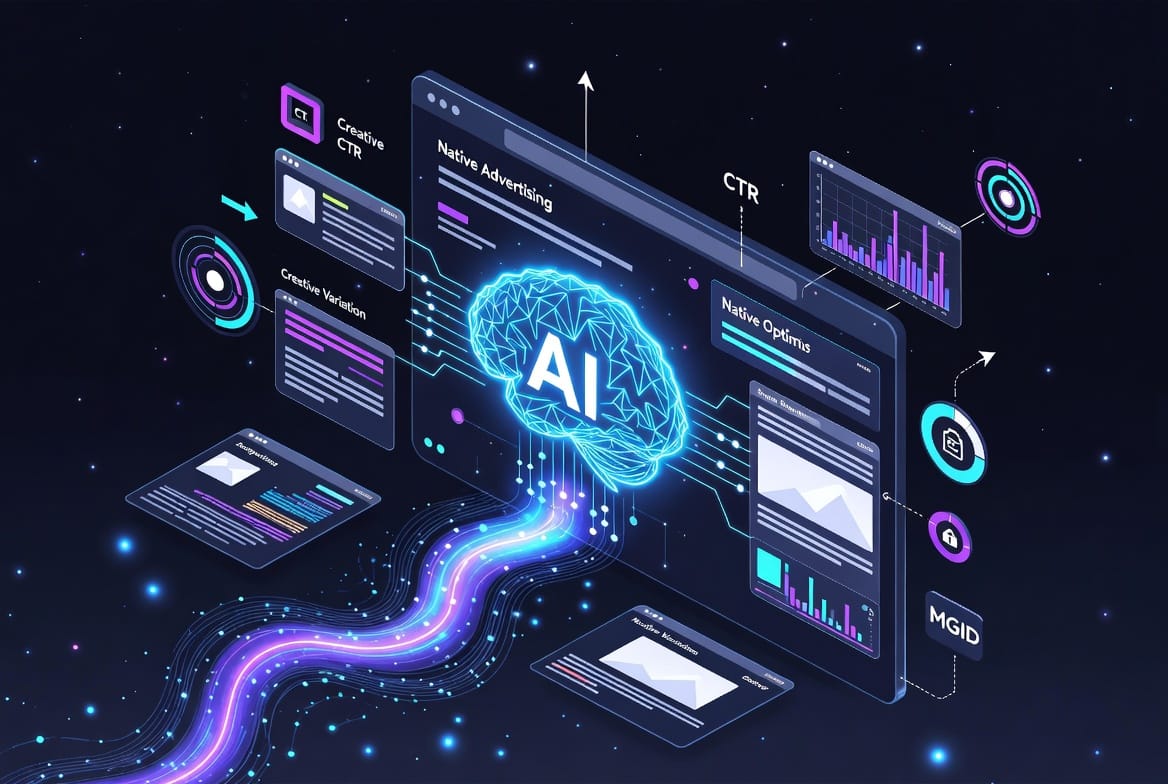
Artificial intelligence has become a central component of modern digital marketing, and native advertising is no exception. As campaigns grow more complex and data-driven, manual optimization is no longer sufficient to maintain performance at scale. Integrating AI into the native advertising workflow allows marketers to improve targeting, automate decision-making, and enhance overall campaign efficiency.
In native advertising – where success depends on relevance, engagement, and user experience – AI plays a particularly important role. MGID is increasingly leveraging machine learning to help advertisers optimize campaigns in real time while maintaining high-quality traffic and contextual alignment.
Why AI Matters in Native Advertising
Native advertising relies on subtlety and relevance rather than interruption. Ads must match the surrounding content, align with user intent, and encourage engagement without feeling intrusive. This creates a complex optimization challenge that AI is uniquely suited to solve.
AI enables advertisers to:
- Process large volumes of data in real time
- Identify patterns in user behavior and engagement
- Automatically adjust targeting and bidding strategies
- Optimize creatives based on performance signals
As a result, campaigns become more efficient, scalable, and adaptive to changing conditions.
Key Areas Where AI Enhances the Workflow
Integrating AI into native advertising is not a single step – it affects multiple stages of the campaign lifecycle.
1. Audience targeting and segmentation
AI analyzes contextual signals, browsing patterns, and engagement behavior to identify high-value audience segments. Instead of relying solely on predefined targeting rules, campaigns dynamically adjust to reach users most likely to engage.
2. Creative optimization
AI systems continuously test headlines, images, and content variations to determine which combinations perform best. This allows advertisers to move beyond static A/B testing and adopt ongoing, real-time optimization.
3. Bid and budget management
Machine learning models evaluate performance metrics and automatically adjust bids or allocate budgets toward high-performing placements. This reduces wasted spend and improves ROI.
4. Traffic quality control
AI helps detect low-quality or fraudulent traffic by analyzing behavioral patterns and engagement anomalies. Platforms like MGID use such systems to prioritize high-quality inventory and maintain campaign integrity.
AI-Driven Optimization Beyond CTR
Traditional optimization often focused on click-through rate (CTR), but in 2026, performance evaluation has shifted toward deeper engagement metrics. AI plays a key role in this transition.
Modern systems optimize for:
- Time on page
- Scroll depth
- Interaction with content
- Post-click navigation
- Conversion likelihood
This allows advertisers to prioritize quality over volume, ensuring that traffic leads to meaningful outcomes rather than superficial clicks.
Integrating AI Into Daily Campaign Management
For advertisers, integrating AI into the workflow does not mean removing human control. Instead, it means combining automation with strategic oversight.
A typical AI-enhanced workflow includes:
- Launching campaigns with initial targeting and creative inputs
- Allowing AI systems to gather performance data
- Monitoring key engagement and conversion metrics
- Adjusting strategic parameters while AI handles micro-optimization
- Scaling based on validated performance signals
This hybrid approach ensures efficiency while maintaining alignment with business goals.
The Role of Contextual Targeting
As privacy regulations limit user-level tracking, AI-driven contextual targeting has become a cornerstone of native advertising. Instead of relying on personal data, AI analyzes the content environment in real time.
Benefits of AI-powered contextual targeting include:
- Privacy compliance
- Immediate relevance to user intent
- Reduced dependency on third-party data
- Improved engagement quality
Native advertising platform MGID is built around this principle, using contextual signals to match ads with appropriate content environments.
Improving Creative Strategy With AI Insights
AI not only optimizes campaigns – it also provides insights that inform creative strategy. By analyzing performance across different creatives, advertisers can identify patterns that influence engagement.
For example, AI can reveal:
- Which headlines drive deeper engagement
- What visual styles perform best in specific GEOs
- How messaging impacts different audience segments
These insights help refine future campaigns and improve overall content quality.
Challenges of AI Integration
Despite its advantages, integrating AI into native advertising comes with challenges.
Common issues include:
- Over-reliance on automation without strategic oversight
- Lack of understanding of how AI models make decisions
- Insufficient data for accurate optimization in early stages
- Difficulty aligning AI outputs with brand voice and messaging
To address these challenges, advertisers should treat AI as a tool rather than a replacement for human expertise.
Scaling Campaigns With AI
One of the most significant benefits of AI is its ability to support scaling without sacrificing performance.
AI enables scalable growth by:
- Automatically expanding into high-performing placements
- Identifying similar audience segments
- Adjusting bids in real time
- Maintaining efficiency across larger budgets
Platforms like MGID use AI-driven distribution systems to allocate traffic dynamically, ensuring that scaling efforts remain aligned with performance goals.
The Future of AI in Native Advertising
AI integration in native advertising is expected to deepen further as technology evolves. Key trends include:
- Greater emphasis on attention-based metrics
- More advanced predictive modeling for conversions
- Increased automation of creative generation
- Deeper integration with privacy-first targeting systems
As these developments continue, AI will become not just a support tool but a core component of campaign strategy.
Conclusion
Integrating AI into the native advertising workflow is no longer optional – it is essential for maintaining competitiveness in a data-driven environment. By automating optimization, improving targeting, and enhancing traffic quality, AI allows advertisers to achieve better results with greater efficiency.
However, the most effective strategies combine AI capabilities with human insight. Platforms like mgid.com demonstrate how this balance can be achieved, offering tools that support automation while maintaining transparency and control.
In a landscape defined by complexity and constant change, AI provides the foundation for smarter, more adaptive native advertising campaigns.
About the Author