Quick Definition
A laparoscopic trocar cannula is a minimally invasive surgical access device used to create stable entry ports for cameras and surgical instruments during laparoscopic procedures while maintaining controlled pneumoperitoneum throughout the operation.
Introduction to Laparoscopic Trocar Cannulas
Minimally invasive surgery has significantly changed the way modern surgical procedures are performed. Compared to open surgery, laparoscopic techniques reduce tissue trauma, shorten hospital stays, minimize postoperative pain, and improve recovery times. One of the most essential components enabling these procedures is the laparoscopic trocar cannula system.
Trocar cannulas function as controlled access ports that allow surgeons to insert cameras, graspers, dissectors, and energy devices into the surgical field through small incisions. These systems must maintain abdominal insufflation pressure while supporting repeated instrument exchanges during surgery.
In laparoscopic procedures, even minor instability in access ports can compromise instrument control and procedural accuracy. Poor trocar performance may affect visualization, increase tissue trauma, and reduce surgical efficiency. Clinics using high-quality laparoscopic trocar cannula systems with multiple sizes can achieve more consistent procedural control and improved operative predictability.
Understanding the Structure of a Trocar Cannula System
A trocar cannula system consists of multiple integrated components designed for safe abdominal access and stable instrument handling.
Trocar Obturator
The obturator is the penetrating component used to enter the abdominal wall. It may feature bladed, blunt, or optical tips depending on the surgical technique and safety requirements.
Cannula Sleeve
The cannula remains inside the incision after insertion and serves as the working channel for laparoscopic instruments.
Valve Mechanism
The valve system helps maintain pneumoperitoneum during instrument insertion and removal.
Insufflation Port
Many trocar systems include side ports that allow controlled carbon dioxide insufflation during surgery.
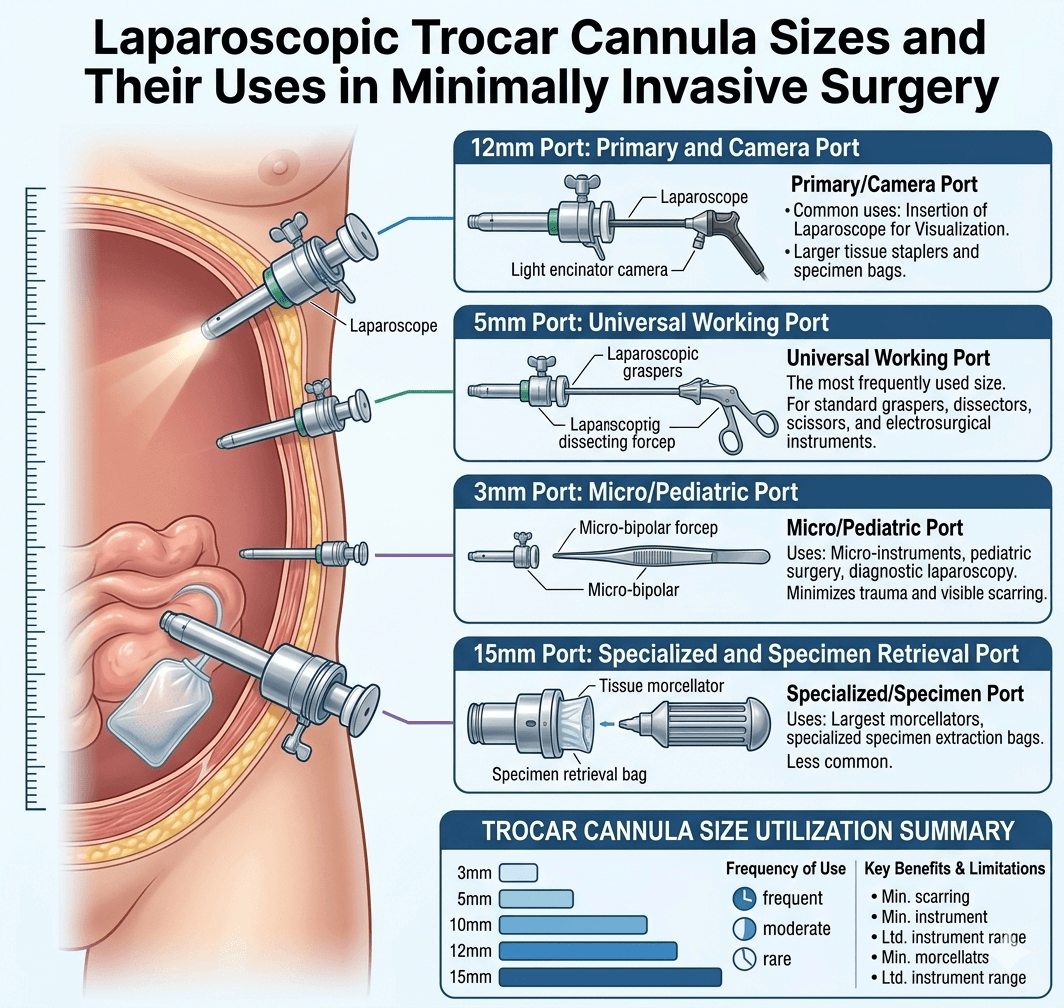
Common Laparoscopic Trocar Cannula Sizes
Different procedures require different trocar diameters depending on instrument compatibility and procedural complexity.
3 mm Trocar Cannula
Primary Uses
3 mm trocar systems are commonly used in pediatric and micro-laparoscopic procedures.
Advantages
- Reduced tissue trauma
- Smaller incision size
- Improved cosmetic outcomes
Limitations
Their smaller diameter limits compatibility with larger surgical devices.
5 mm Trocar Cannula
Primary Uses
The 5 mm trocar is one of the most commonly used sizes in minimally invasive surgery.
Clinical Applications
- Laparoscopic cholecystectomy
- Diagnostic laparoscopy
- Gynecologic procedures
- Appendectomy
Advantages
This size balances procedural versatility with reduced invasiveness.
10 mm Trocar Cannula
Primary Uses
10 mm systems are generally used for laparoscopic cameras, clip appliers, staplers, and specimen extraction.
Clinical Applications
- Bariatric surgery
- Colorectal surgery
- Advanced laparoscopic procedures
Advantages
These ports support larger instruments and improved visualization systems.
12 mm Trocar Cannula
Primary Uses
12 mm trocar systems are commonly used in advanced laparoscopic and robotic procedures.
Clinical Applications
- Oncologic surgery
- Robotic-assisted surgery
- Complex gastrointestinal procedures
Advantages
They accommodate advanced energy devices and large-diameter instruments.
Types of Laparoscopic Trocar Cannulas
Bladed Trocar Cannulas
Bladed trocars use sharp cutting tips for easier abdominal entry. They provide low insertion resistance but require careful control to reduce tissue injury risk.
Blunt Trocar Cannulas
Blunt systems separate tissue layers instead of cutting them. These are often preferred in procedures emphasizing tissue preservation.
Optical Trocar Cannulas
Optical systems allow surgeons to visualize tissue layers during insertion, improving placement accuracy and reducing the risk of internal injury.
Balloon Trocar Cannulas
Balloon trocars provide internal fixation after insertion and help stabilize the access port during prolonged procedures.
Trocar Size Selection in Minimally Invasive Surgery (Expert Insight)
Selecting the appropriate trocar size depends on several surgical factors, including instrument diameter, procedure type, patient anatomy, and required visualization quality. Smaller ports reduce tissue trauma but may limit compatibility with advanced laparoscopic devices.
Larger trocar systems improve access and allow the use of staplers, specimen retrieval systems, and high-capacity energy devices. However, increasing port size may also increase postoperative discomfort and incisional hernia risk.
Surgeons must balance procedural access requirements with patient safety considerations. High-quality minimally invasive surgical access devices help maintain controlled instrument movement while reducing insertion resistance and tissue stress.
Access Challenges in Laparoscopic Surgery (Advanced Insight)
Safe abdominal access remains one of the most technically sensitive aspects of laparoscopic surgery. Improper trocar placement can result in vascular injury, organ perforation, or loss of pneumoperitoneum.
Patients with obesity, previous abdominal surgery, or dense scar tissue often present additional access challenges. Increased abdominal wall thickness may require longer cannulas and improved stabilization mechanisms to maintain procedural control.
Even with advanced trocar systems, surgical judgment and insertion technique remain critical for minimizing complications and maintaining safe access throughout the procedure.
Trocar Stability and Pneumoperitoneum Control (Advanced Insight)
Maintaining trocar stability is essential for consistent instrument control during minimally invasive surgery. Excessive port movement can compromise precision, enlarge incision sites, and increase gas leakage.
High-quality trocar systems use advanced valve mechanisms and secure fixation designs to maintain pneumoperitoneum during repeated instrument exchanges. Stable access ports improve visualization and reduce procedural interruptions.
Poorly stabilized trocar systems may compromise surgical efficiency and directly affect operative accuracy.
Instrument Ergonomics and Surgeon Fatigue
In lengthy laparoscopic procedures, ergonomics directly influence hand stability and procedural consistency. Poor weight balance or excessive insertion resistance can increase surgeon fatigue and reduce movement precision during delicate maneuvers.
Ergonomically optimized laparoscopic trocar cannula systems with multiple sizes improve instrument passage and support a smoother surgical workflow. Stable access platforms reduce unnecessary resistance and help maintain precision throughout prolonged procedures.
Hospitals aiming to standardize minimally invasive procedures often rely on complete laparoscopic access systems to maintain consistency across surgical departments.
Laparoscopic Trocar Cannulas vs Traditional Open Surgical Access
Feature: Laparoscopic Trocar Cannula, Traditional Open Surgery
Incision Size Small Large
Tissue Trauma Minimal Higher
Recovery Time Faster Longer
Visualization Camera-assisted Direct exposure
Infection Risk Lower Higher
Cosmetic Results: Improved, more visible scarring
Minimally invasive access systems have improved patient recovery and reduced postoperative complications across multiple surgical specialties.
Risks of Using Low-Quality Trocar Systems
Poorly manufactured trocar systems may compromise insertion accuracy, sealing performance, and structural stability. Inadequate valve systems can lead to gas leakage and unstable pneumoperitoneum during surgery.
Low-quality obturators may increase insertion resistance or create uncontrolled tissue trauma. Poor access control can reduce instrument precision and increase the likelihood of intraoperative complications.
Clinics investing in premium laparoscopic trocar cannula systems often achieve more reliable procedural outcomes and improved surgical workflow efficiency.
Materials and Manufacturing Standards
Modern trocar systems are manufactured using surgical-grade stainless steel and advanced medical polymers designed for repeated sterilization and long-term durability.
Precision manufacturing is essential for ensuring:
- Smooth instrument passage
- Reliable valve sealing
- Controlled insertion performance
- Structural stability
High manufacturing standards directly contribute to safer and more consistent surgical access.
Sterilization and Maintenance Protocols
Proper sterilization protocols are critical for infection prevention and instrument longevity. Cannulas, valves, and obturators must be thoroughly cleaned after every procedure to prevent debris accumulation and maintain performance integrity.
Routine inspection helps identify wear-related issues before they affect surgical reliability.
Role of Trocar Cannulas in Modern Laparoscopic Surgery
As minimally invasive surgery continues to evolve, trocar systems remain central to procedural efficiency and surgical precision. Advanced laparoscopic procedures increasingly depend on specialized access platforms that support stable visualization and controlled instrument handling.
Clinics using complete laparoscopic trocar cannula systems with multiple sizes can better adapt to varying procedural requirements while maintaining workflow consistency across surgical specialties.
Conclusion
Laparoscopic trocar cannulas are foundational components of minimally invasive surgery, providing stable and controlled access for cameras and surgical instruments. Different trocar sizes support varying procedural requirements, from pediatric laparoscopy to advanced robotic surgery.
Proper trocar selection, high-quality manufacturing, and ergonomic design all contribute directly to surgical precision, safety, and procedural efficiency. Clinics prioritizing premium laparoscopic trocar cannula systems with multiple sizes can achieve more consistent operative performance and improved patient outcomes.
FAQs
1. What is a laparoscopic trocar cannula used for?
It creates access ports for laparoscopic cameras and surgical instruments during minimally invasive procedures.
2. What are the common laparoscopic trocar sizes?
Common sizes include 3 mm, 5 mm, 10 mm, and 12 mm.
3. Why are different trocar sizes required?
Different procedures and instruments require specific port diameters for compatibility and surgical control.
4. What is the difference between a trocar and a cannula?
The trocar penetrates tissue, while the cannula remains in place as the working access channel.
5. Are laparoscopic trocar systems reusable?
Many systems are reusable after proper sterilization, although disposable variants are also available.
About the Author