Businesses today collect data from almost every corner of their operations. Website visits, customer behavior, sales records, payment activity, app usage, support tickets, and internal systems all create useful signals. The problem is that raw data does not help much until it is cleaned, connected, and turned into action.
This is where a big data analytics service becomes valuable. It helps businesses study large volumes of data, find patterns, and predict what may happen next. For Malaysian companies, this can mean better forecasting, smarter customer decisions, stronger risk detection, and faster planning at scale.
What Is a Big Data Analytics Service?
A big data analytics service helps businesses collect, process, and study large amounts of data from different sources. This data may come from websites, mobile apps, customer systems, payment records, cloud platforms, sales tools, or daily operations.
The goal is simple. It turns messy data into useful business insight.
Many companies already have valuable data, but it is often scattered across too many places. One team may store customer data in a CRM. Another team may track sales in spreadsheets. Operations may use a separate system. Finance may have its own records. When these systems do not connect, leaders only see part of the picture.
A proper big data setup brings these signals together. It cleans the data, removes errors, organizes information, and makes it easier to analyze. From there, businesses can build dashboards, reports, alerts, and prediction models.
For Malaysian businesses, this matters because competition is moving fast. Retailers need to understand demand. Banks and fintech firms need to detect unusual activity. Logistics teams need to plan routes and delivery capacity. Online platforms need to understand user behavior in real time.
A big data analytics service gives companies the structure to make better decisions based on facts, not guesswork.
How Big Data Analytics Creates Predictive Insights
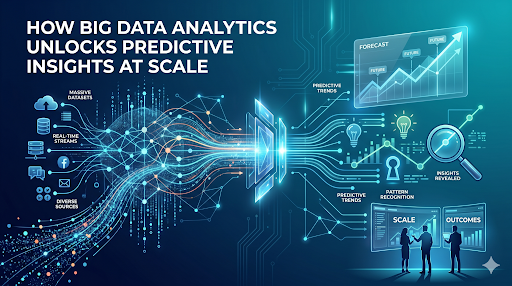
Big data analytics creates predictive insights by studying past and current data to identify patterns. These patterns help businesses estimate what may happen next.
For example, a retail company can study purchase history, seasonal trends, website traffic, and customer behavior. From there, it can forecast which products may sell faster during a campaign. A finance company can study transaction patterns and detect activity that looks unusual. A logistics company can use delivery records, traffic data, and order volume to plan capacity before demand increases.
This is where prediction becomes useful. It does not replace business judgment. It supports it with clearer evidence.
Machine learning also plays an important role. Once a model studies enough data, it can start recognizing signals that are hard to spot manually. It can identify customers who may stop using a service, products that may run out soon, or system issues that may affect performance.
At scale, these insights become even more powerful. Instead of reacting after a problem happens, businesses can act earlier. They can prepare stock, adjust campaigns, improve service, manage risks, and allocate resources with more confidence.
For growing Malaysian companies, predictive insights help teams move faster without relying only on instinct.
Why Scale Matters in Big Data Analytics
Scale matters because business data does not stay small for long. As a company grows, every transaction, customer visit, support request, app session, and system activity adds more data to the business. At first, a spreadsheet or manual report may be enough. Over time, that approach becomes slow, messy, and hard to trust.
A scalable data system can handle larger data volume without breaking the workflow. It can process information from different departments, update reports faster, and support more complex analysis. This is important when leaders need timely answers, not outdated numbers from last week.
Cloud infrastructure also plays a major role. A strong cloud setup gives businesses the storage, computing power, and flexibility needed to run analytics across large datasets. It also helps teams scale up when demand increases and scale down when usage is lower.
For predictive analytics, this matters even more. Prediction models need clean data, stable systems, and enough processing power to study patterns properly. If the foundation is weak, the insights may become slow, incomplete, or inaccurate.
A big data analytics service helps businesses build this foundation. It supports growth, reduces manual work, and gives teams a more reliable way to turn large scale data into useful decisions.
Key Benefits for Malaysian Businesses
A big data analytics service gives Malaysian businesses a clearer way to plan, compete, and grow. The first major benefit is better forecasting. Companies can study sales patterns, customer demand, seasonal behavior, and market activity to estimate what may happen next. This helps teams prepare stock, plan budgets, manage manpower, and reduce waste.
It also supports faster decision making. Instead of waiting for manual reports, teams can use dashboards and real time insights to understand what is working and what needs attention. This is useful for fast moving sectors like ecommerce, fintech, logistics, and digital services.
Another key benefit is stronger customer understanding. Big data can show what customers buy, when they return, where they drop off, and which offers they respond to. With this insight, businesses can personalize campaigns, improve user journeys, and build better customer experiences.
Risk detection also becomes stronger. Analytics can help identify unusual transactions, abnormal system activity, suspicious behavior, or early warning signs before they become bigger problems. This is especially valuable for companies handling payments, user accounts, sensitive data, or high transaction volumes.
Operational efficiency improves as well. Businesses can spot delays, wasted costs, repeated errors, and underused resources. Over time, these improvements can lead to better service, leaner operations, and smarter growth.
For Malaysian companies that want to scale, big data is not just about reports. It is about making better moves before the market forces them to react.
Practical Use Cases Across Malaysian Industries
Big data analytics can support many industries in Malaysia because almost every sector now depends on digital activity, customer behavior, and operational data.
In retail and ecommerce, businesses can use analytics to forecast demand, study buying habits, recommend products, and improve campaign timing. This helps teams avoid overstocking slow moving items and missing demand for popular products.
In finance and digital payments, big data can support fraud detection, customer risk scoring, transaction monitoring, and behavior analysis. When unusual activity appears, businesses can respond earlier and reduce potential losses.
In logistics, analytics can help companies plan routes, manage delivery capacity, track delays, and predict peak periods. This is useful for delivery providers, warehouses, and companies managing nationwide distribution.
In the public sector, big data can support better service planning, secure digital identity systems, and data driven policy decisions. When combined with cloud infrastructure and strong cybersecurity, it helps build more reliable digital services for citizens.
Technology platforms can also benefit from predictive insights. Apps, marketplaces, SaaS platforms, and online services can study user behavior, system performance, and engagement patterns. This helps teams improve product features, reduce churn, and scale with more confidence.
These use cases show why a big data analytics service is becoming more important. It helps organizations turn daily data into practical insight that supports real business action.
Why Choose Zchwantech for Big Data Analytics Service
Zchwantech is a practical technology partner for businesses that want to turn data into smarter decisions. Its work covers key areas that support modern analytics, including AI and data intelligence, cloud infrastructure, cybersecurity, custom application development, crypto solutions, and biometric digital identity.
This matters because predictive analytics does not work well as a standalone tool. It needs a strong technical foundation. Data must be collected properly, stored securely, processed at scale, and connected to systems that teams actually use. Without that foundation, businesses may end up with reports that look good but do not create real impact.
Zchwantech’s technology focus helps businesses approach data in a more complete way. Cloud infrastructure supports scalability. Cybersecurity protects sensitive information. Custom application development allows analytics tools to fit real workflows. AI and data intelligence help businesses move from basic reporting to predictive insight.
For Malaysian companies, this kind of support can make big data easier to use. It gives teams a clearer path from raw information to practical action, whether the goal is better forecasting, stronger risk detection, improved customer experience, or smarter operational planning.
Conclusion
A big data analytics service helps businesses move from reactive decisions to predictive planning. It gives Malaysian companies a better way to understand customers, forecast demand, detect risk, improve operations, and scale with more confidence.
As data grows, the companies that can read patterns early will have a stronger advantage. Zchwantech supports this shift with technology solutions built around data intelligence, cloud infrastructure, cybersecurity, custom development, and secure digital transformation.
For businesses ready to turn data into predictive insights at scale, contact Zchwantech at sales@zchwantech.com.
About the Author