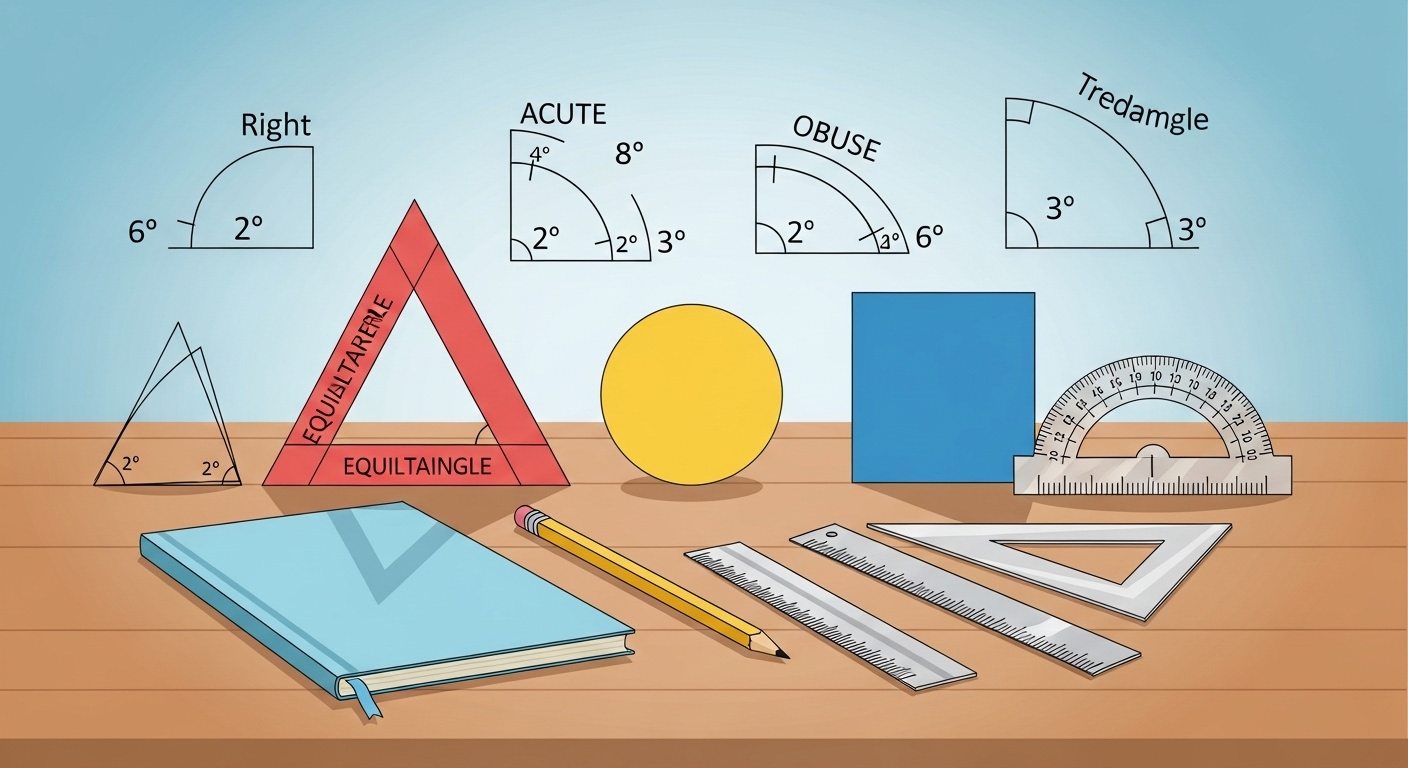
Have you ever looked at a ball, a door, or even a slice of pizza and wondered why they look the way they do? Geometry helps you answer those questions. Geometry learn v3 is a simple way to start understanding the world of shapes and angles. It shows how lines, points, and curves come together to make everything from tiny snowflakes to big buildings. Learning these ideas is important because they appear in daily life, from drawing pictures to building houses. Once you know the basics, you will see geometry everywhere, and it will feel fun and useful.
This guide will take you step by step through the main parts of geometry. We will use easy words and real examples so that you can follow along without any trouble. By the end, you will feel more confident about shapes and angles.
What Is Geometry and Why Does It Matter?
Geometry is the part of math that studies shapes, sizes, positions, and angles of things. It started long ago when people needed to measure land and build strong structures. Today, it still helps in many ways. For example, when you play with blocks as a child, you are already using simple geometry ideas without knowing it.
Another thing is that geometry trains your brain to think clearly. It teaches you to notice details, like how sides match or how corners fit together. In addition, it connects to other subjects such as art, science, and even sports. Over time, understanding geometry makes everyday tasks easier, like packing a suitcase neatly or reading a map. That’s why starting with geometry learn v3 gives you a strong foundation that grows with you.
Starting with the Smallest Ideas: Points, Lines, and Planes
Everything in geometry begins with very basic building blocks. First comes the point. A point is just a single spot or location. It has no size at all, no length or width. You can think of it like a tiny dot you make with a pencil on paper. We name points with capital letters, such as point A or point B. Because a point shows exact position, it helps us mark places in drawings.
Next, lines come from connecting many points. A line is a straight path that goes on forever in both directions. It has length but no thickness. For example, imagine the edge of a long road that stretches as far as you can see in both ways. In geometry, we show a line with arrows on both ends to mean it never stops.
After that, there are line segments and rays. A line segment is a part of a line with two clear ending points. It has a fixed length, like the side of a book or the straight edge of a ruler. A ray is different because it starts at one point and goes forever in only one direction. Think of a flashlight beam that begins at the light and shines outward without end. These simple ideas connect smoothly because lines, segments, and rays help form bigger shapes.
Planes are another important part. A plane is a flat surface that goes on forever, like an endless sheet of paper. Points and lines live on planes. For instance, the top of your desk is part of a plane, even if the real desk has edges. Understanding these basics is key because they build everything else in geometry learn v3.
Understanding Angles: How Lines Meet and Turn
When two lines or rays meet at a point, they create an angle. The meeting point is called the vertex. Angles measure how much one line turns away from the other. We measure angles in degrees, shown with a little circle symbol like this: °.
There are different kinds of angles, and each has its own feel. A right angle measures exactly 90°. It looks like the corner of a square book or the way walls meet the floor in a room. Right angles feel strong and neat. Next, acute angles are smaller than 90°. They are sharp, like the point of a slice of pizza or the tip of a leaf. In addition, obtuse angles are bigger than 90° but smaller than 180°. They open wider, like the angle you make when you stretch your arms out a little more than straight.
Straight angles measure 180° and look like a flat line. That’s why they are called straight. Another thing is that angles can be next to each other and add up in special ways. For example, two angles that share a side and add to 180° are called supplementary. Complementary angles add to 90°. These relationships help when you solve puzzles or build things.
In real life, angles appear when you open a door or kick a ball. Athletes use angles to aim throws or shots. Because angles control direction and turn, learning them in geometry learn v3 makes you better at noticing how things move and fit.
Common Shapes You See Every Day: Triangles and Quadrilaterals
Shapes made with straight sides are called polygons. Triangles are the simplest polygons because they have three sides and three angles. The sum of the angles inside any triangle is always 180°. This rule is very useful. For example, if you know two angles, you can find the third one easily.
Triangles come in different types. An equilateral triangle has all sides the same length and all angles the same size, 60° each. It looks balanced and fair. An isosceles triangle has two equal sides, so two angles match too. A scalene triangle has all sides and angles different. Right triangles have one 90° angle, and they often appear in roofs or ramps. These differences matter because each type behaves in its own way when you measure or move it.
Next come quadrilaterals, which have four sides. A square is a special quadrilateral with four equal sides and four right angles. It feels solid and even. A rectangle has four right angles but opposite sides are equal, like a door or a phone screen. Parallelograms have opposite sides that are parallel and equal. Rhombuses have all sides equal, and trapezoids have only one pair of parallel sides.
You can find these shapes in windows, floors, and signs. For instance, many city streets form rectangles and squares when viewed from above. Learning about triangles and quadrilaterals in geometry learn v3 helps you see patterns in buildings and designs around you.
Circles and Curved Shapes
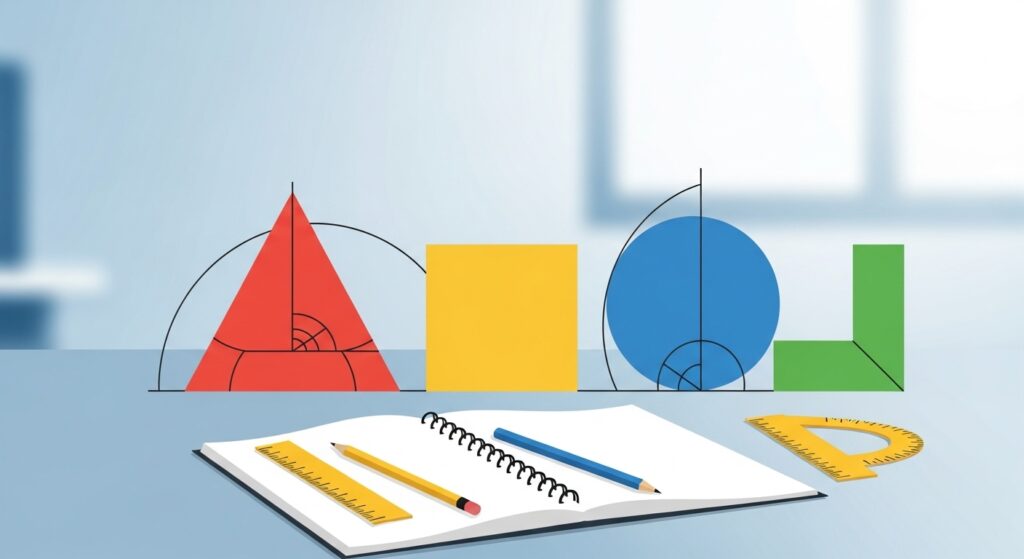
Not all shapes have straight lines. Circles are round and perfect in their own way. A circle is a set of points that are all the same distance from a center point. That distance is called the radius. The full distance across through the center is the diameter, which is twice the radius.
The distance around a circle is the circumference. Circles have no corners, so they roll smoothly. That’s why wheels and coins are circular. In nature, you see circles in the sun, in drops of water, and even in tree rings. Another thing is that parts of circles, like arcs or sectors, appear in slices of cake or fans.
Circles connect to angles too. A full circle measures 360°. Half a circle is 180°, which matches a straight angle. Because circles are symmetric, they help create balanced designs in art and machines.
How Geometry Appears in Real Life
Geometry is not just in books. It surrounds us every day. In buildings, architects use angles and shapes to make sure houses and bridges stand strong. Triangles add support because they do not easily change shape when pushed. That’s why many bridges have triangular parts.
In nature, snowflakes show beautiful six-sided patterns, which are hexagons. Sunflower seeds arrange in spirals that follow geometric rules for best space use. Even spider webs use radial lines and circles to catch food.
Sports also rely on geometry. When you throw a ball, the path follows curves and angles. Players choose the best angle to score. In addition, maps and navigation use lines and angles to show directions. GPS systems calculate positions with triangles.
In 2026, geometry remains important in new fields like computer design and virtual worlds. Artists create games and animations using shapes and angles to make realistic movements. Simple examples like folding paper or cutting fruit show geometry in action at home. These real-life connections make learning geometry learn v3 feel meaningful and exciting.
Practical Tips to Learn Geometry Better
To understand shapes and angles well, practice drawing them by hand. Start with points and lines, then add angles and close them into triangles or squares. Use everyday objects as examples. Look at your room and name the shapes you see on the walls or furniture.
Measure angles with a simple tool like a protractor if you have one. Compare angles around you, such as the corner of a table versus the slant of a roof. Another helpful tip is to break problems into small steps. First identify the points and lines, then look at the angles, and finally check the shapes.
Avoid common mistakes to save time. One mistake is thinking a drawing is perfectly accurate just by looking. Always use given measurements instead of guessing from the picture. Another error is mixing up names of shapes or angles. For example, do not confuse a ray with a full line. Also, remember that orientation does not change a shape. A triangle stays a triangle even if you turn it upside down.
In addition, always label your work clearly with letters for points. This habit prevents confusion later. Over time, these tips will help you solve problems faster and remember ideas longer.
Mistakes to Avoid When Studying Shapes and Angles
Many beginners rush and assume things that are not stated. For instance, they might think two lines are parallel just because they look that way in a sketch. Always check for exact information. Another common slip is forgetting that the inside angles of a triangle add to 180°. Double-check your additions.
Some students mix up similar shapes with identical ones. Similar shapes have the same angles but can be different sizes. Congruent shapes are exactly the same in size and shape. Pay attention to these words. Also, be careful with units when measuring. Say degrees for angles and clear lengths for sides.
By watching for these mistakes, you build good habits early. Geometry learn v3 becomes much easier when you stay patient and check your steps.
FAQ About Learning Geometry
Here are some questions people often ask about basic geometry.
What is the easiest way to remember the types of angles?
Think of them by how open they feel. Acute is sharp and small, right is like a square corner, and obtuse is wide and open. Practice by finding examples in your home.
Why do all triangles have angles that add up to 180°?
This rule comes from the way straight lines and turns work together. If you tear the corners of a triangle and put them side by side, they form a straight line of 180°.
How can I tell a square from a rectangle?
A square has all four sides equal, while a rectangle has opposite sides equal and all right angles. Both have right angles, but the sides make the difference.
Do circles have angles inside them?
Yes, but they are measured at the center or around the edge. A full turn around the center is 360°.
Is geometry only about flat shapes?
No. After flat shapes, you can learn about solid shapes like cubes and spheres that have height, width, and depth.
What is a real-life use of parallel lines?
Railway tracks are parallel. They never meet and keep the same distance, which helps trains run smoothly.
How does learning geometry help in art?
Artists use shapes, symmetry, and angles to create balanced and beautiful pictures or sculptures.
Final Thoughts on Your Geometry Journey
Geometry learn v3 opens a clear path to understanding shapes and angles. You started with simple points and lines, moved through angles and flat shapes, and saw how they connect to circles and real life. Along the way, practical tips and awareness of common mistakes help you learn steadily without frustration.
Remember that geometry is like a story where small ideas build into bigger ones. Keep practicing with things you see every day, and the ideas will stick naturally. As you grow, you will discover even more ways geometry shapes the world.
Keep exploring with curiosity. Shapes and angles are all around, waiting for you to notice them. Enjoy the journey, and soon you will see the beauty and usefulness in every line and turn.
Disclaimer:
This article provides general educational information on basic geometry concepts for learning purposes only. It is not intended as professional advice, a substitute for classroom teaching, or any formal curriculum. Readers should consult qualified educators or textbooks for specific academic needs. All examples are illustrative and based on standard mathematical principles.
Explore More
- What Is Q268300D? Full Overview, Benefits, and Details
- Brasssmile Com Explained: What It Is, How It Works, and Benefits
- What Is Jememôtre? Complete Beginner Guide and Overview
About the Author