Organizations across industries are under constant pressure to improve operational efficiency, strengthen cybersecurity, accelerate innovation, and manage increasingly complex technology environments. Traditional IT functions are no longer viewed solely as support centers. Instead, they play a critical role in enabling business growth, digital transformation, and competitive advantage.
Artificial intelligence (AI) is rapidly changing the way IT organizations operate. By combining machine learning, predictive analytics, automation, and intelligent decision-making capabilities, AI helps IT teams optimize processes, reduce costs, improve service delivery, and enhance user experiences. As enterprises continue to modernize their technology ecosystems, AI has become an essential component of future-ready IT strategies.
The Rise of AI in IT Operations
Artificial intelligence in IT refers to the application of AI technologies to improve IT operations, infrastructure management, service delivery, security, and business outcomes. AI enables organizations to process vast amounts of data, identify patterns, automate routine tasks, and generate actionable insights that support more effective decision-making.
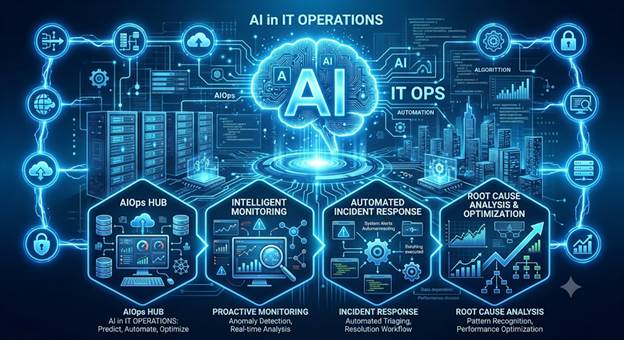
Modern AI-powered IT solutions extend beyond simple automation. They can monitor system performance in real time, predict infrastructure failures, detect cybersecurity threats, optimize resource allocation, and support intelligent service management.
As organizations seek to modernize technology operations, many are investing in AI in IT initiatives to improve efficiency, scalability, and business agility. These solutions help IT leaders shift from reactive management approaches to proactive and predictive operational models.
1. Core technologies powering AI in IT
AI adoption in IT relies on several advanced technologies working together to improve operational effectiveness.
Key technologies include:
- Machine learning
- Natural language processing
- Predictive analytics
- Intelligent automation
- Generative AI
- Data analytics
- Computer vision
- AIOps platforms
These technologies enable organizations to automate complex workflows while improving decision-making across IT environments.
2. Evolution of AI-driven IT operations
Traditional IT operations often relied on manual monitoring, troubleshooting, and maintenance processes. As technology infrastructures expanded, these approaches became increasingly difficult to manage efficiently. AI-driven IT operations introduce intelligent monitoring capabilities that continuously analyze system performance, identify anomalies, and recommend corrective actions. This helps organizations improve uptime, reduce service disruptions, and strengthen operational resilience.
3. Growing importance of AI in digital transformation
Digital transformation initiatives generate massive volumes of data across enterprise systems. AI enables organizations to convert this data into actionable insights that support innovation and business growth. By integrating AI capabilities into IT operations, businesses can improve agility, accelerate technology adoption, and support more efficient service delivery models.
Benefits of AI in IT Operations
Organizations implementing AI across IT functions can achieve significant operational, financial, and strategic benefits.
1. Improved operational efficiency
AI automates repetitive and time-consuming tasks such as system monitoring, ticket routing, incident management, and infrastructure maintenance. This allows IT professionals to focus on higher-value activities that drive business outcomes. Automation also reduces manual errors and improves consistency across operational processes.
2. Faster issue detection and resolution
AI-powered monitoring tools can identify anomalies and performance issues before they escalate into major incidents. Predictive analytics helps IT teams detect potential failures and take corrective action proactively. This reduces downtime, improves service reliability, and enhances overall user experiences.
3. Enhanced cybersecurity capabilities
Cybersecurity threats continue to grow in sophistication and frequency. AI strengthens security operations by analyzing large volumes of security data, identifying unusual activity patterns, and detecting potential threats in real time. AI-driven threat detection improves incident response times and helps organizations better protect critical business assets.
4. Better decision-making through analytics
AI provides IT leaders with actionable insights derived from complex datasets. Advanced analytics help organizations evaluate performance trends, optimize technology investments, and improve resource allocation decisions. Data-driven decision-making supports more effective IT governance and strategic planning.
5. Reduced operational costs
Intelligent automation reduces the need for manual intervention across many IT processes. Organizations can streamline operations, improve productivity, and lower administrative costs. Cost savings generated through AI adoption can be redirected toward innovation and digital transformation initiatives.
6. Increased scalability and flexibility
AI enables organizations to manage growing technology environments more effectively. Intelligent systems can dynamically allocate resources, optimize workloads, and support evolving business requirements. This scalability helps organizations adapt to changing market conditions and technology demands.
Use Cases of AI in IT
AI is being applied across numerous IT functions to improve operational performance and business outcomes.
1. IT service management
AI-powered service management solutions automate ticket classification, routing, prioritization, and resolution recommendations. Virtual assistants and intelligent chatbots can also handle common user requests and support inquiries. This improves service desk efficiency while enhancing employee satisfaction.
2. Infrastructure monitoring and management
AI continuously monitors infrastructure performance across networks, servers, databases, and cloud environments. Intelligent monitoring systems can identify performance issues, predict failures, and recommend remediation actions. Organizations benefit from improved uptime and more reliable technology operations.
3. Cybersecurity and threat detection
AI plays a critical role in modern cybersecurity strategies. Security teams use AI to analyze network activity, detect suspicious behavior, and respond to emerging threats more effectively. Machine learning algorithms can identify attack patterns that may be difficult for traditional security tools to detect.
4. Cloud optimization
Organizations increasingly rely on cloud environments to support business operations. AI helps optimize cloud resource utilization, manage costs, and improve performance. Intelligent analytics can identify inefficiencies and recommend adjustments that maximize cloud investments.
5. Predictive maintenance
AI-powered predictive maintenance solutions analyze equipment performance data to identify potential failures before they occur. This proactive approach reduces downtime, extends asset life cycles, and improves operational reliability.
6. Data management and analytics
AI enhances data management processes by improving data classification, quality monitoring, and analytics capabilities. Organizations can gain deeper insights from enterprise data while improving governance and compliance initiatives.
Organizations pursuing large-scale AI initiatives often engage specialized AI consulting services to develop implementation strategies, identify high-value use cases, and accelerate business adoption.
Why Choose The Hackett Group® For Implementing AI in IT?
Successfully implementing AI within IT environments requires a combination of strategic expertise, technology knowledge, operational benchmarking, and proven transformation methodologies. The Hackett Group® helps organizations navigate AI adoption while aligning technology investments with measurable business outcomes.
1. Deep technology and benchmarking expertise
The Hackett Group® is widely recognized for its extensive benchmarking capabilities and performance research across enterprise functions. Organizations gain access to data-driven insights that help identify improvement opportunities and prioritize AI investments effectively. These insights support smarter decision-making and accelerate transformation initiatives.
2. Proven digital transformation experience
Implementing AI successfully requires more than technology deployment. Organizations must align people, processes, governance, and technology to maximize value. The Hackett Group® provides strategic guidance that helps organizations integrate AI capabilities into broader digital transformation initiatives while minimizing implementation risks.
3. Advanced AI-powered intelligence and collaboration
The Hackett AI XPLR™ platform, AskHackett™, and Hackett Connect® provide organizations with AI-enabled insights, benchmarking intelligence, and collaboration capabilities that support informed decision-making and operational improvement. These capabilities help organizations accelerate AI adoption while maintaining alignment with business objectives.
4. Focus on measurable business outcomes
Successful AI initiatives should deliver tangible and sustainable results. The Hackett Group® emphasizes outcome-focused strategies designed to improve operational efficiency, service quality, workforce productivity, and technology performance. This results-oriented approach helps organizations maximize the value of AI investments and achieve long-term business benefits.
Conclusion
Artificial intelligence is transforming the role of IT from a reactive support function into a strategic driver of business value. By leveraging machine learning, predictive analytics, intelligent automation, and advanced data insights, organizations can improve operational efficiency, strengthen cybersecurity, optimize infrastructure management, and accelerate innovation.
The benefits of AI extend across virtually every aspect of IT operations, from service management and cloud optimization to predictive maintenance and threat detection. As technology environments become increasingly complex, AI provides the intelligence and automation needed to improve agility and support sustainable growth.
Organizations that strategically adopt AI within their IT functions will be better positioned to improve performance, enhance user experiences, and create long-term competitive advantages in an increasingly digital business landscape.
About the Author