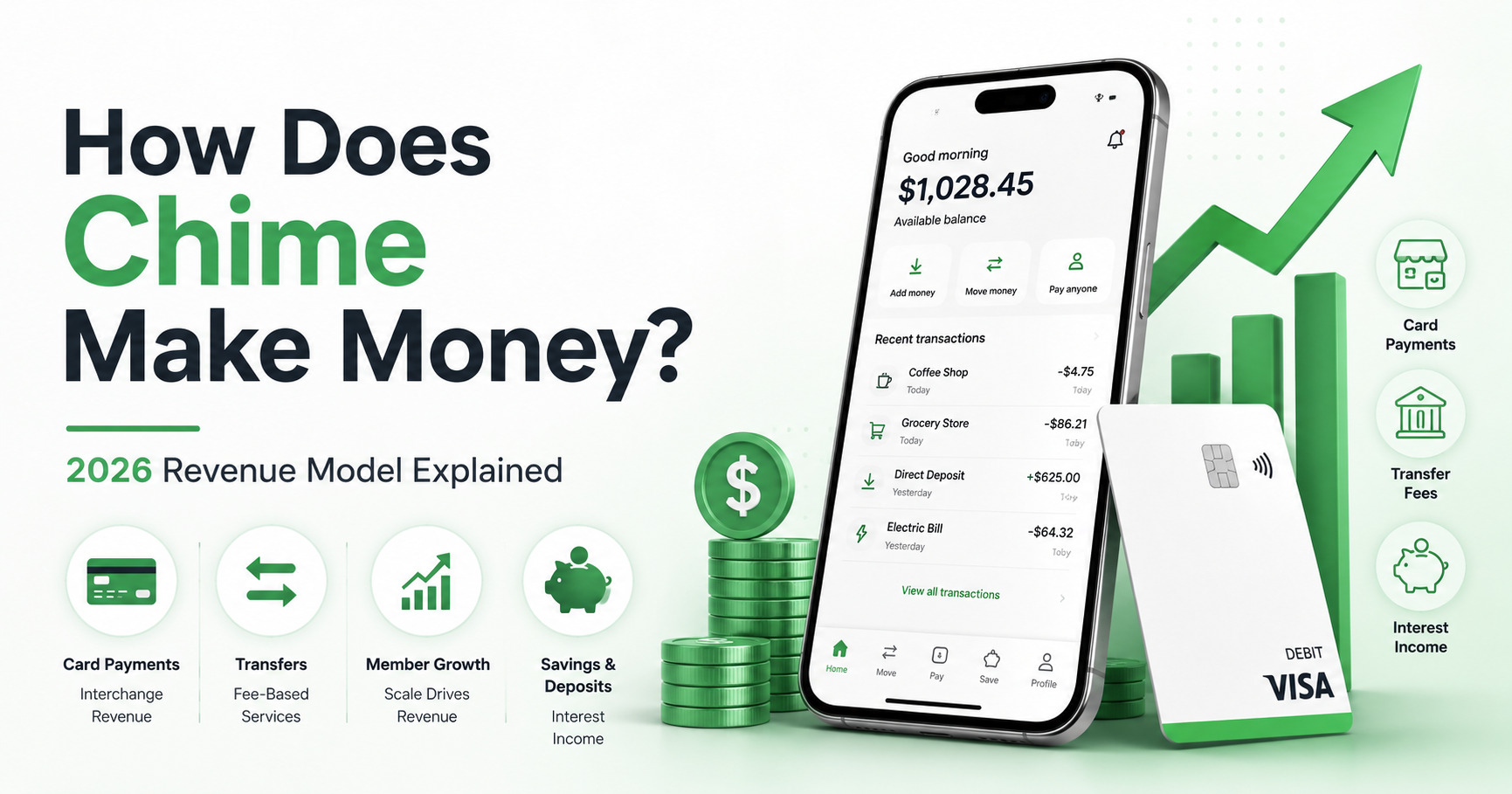
Chime is known for offering a simple, mobile-first banking experience with fewer of the fees people associate with traditional checking accounts. That can make its business model seem confusing. If customers are not paying a monthly maintenance fee, How Does Chime Make Money?
The answer is mostly about activity rather than account ownership. Chime earns money when members use Chime-branded debit and credit cards, use certain financial products such as MyPay or Instant Loans, make some instant transfers, use certain ATMs, deposit cash through paid locations, and interact with selected partner services. Chime itself is a financial technology company rather than a chartered bank, so banking services are provided through partner banks.
This model has grown well beyond card swipes. In the second quarter of 2026, Chime reported total revenue of about $669.8 million, including roughly $430 million in payments revenue and $239.7 million in platform-related revenue.
How Does Chime Make Money?
In simple terms, Chime has two main revenue engines:
- Payments revenue, mainly generated from debit and credit card interchange fees.
- Platform-related revenue, generated from products such as MyPay, Instant Loans, outbound instant transfers, ATM activity, SpotMe tips, cash deposits, partnerships, and high-yield savings accounts.
So, How Does Chime Make Money? Mostly by becoming part of a member’s everyday financial activity.
When someone gets paid through Chime and then uses a Chime card to buy groceries, pay for gas, shop online, or cover everyday expenses, those transactions can generate interchange revenue. If that member also uses products such as MyPay or Instant Loans, Chime has additional opportunities to earn platform revenue.
That approach lets Chime offer many core services without depending on a monthly account charge.
Quick Answer
Here is the Chime revenue model at a glance:
| Revenue Source | How Chime Earns |
|---|---|
| Debit card interchange | Revenue from eligible Chime debit card purchases |
| Credit card interchange | Revenue generated through Chime-branded secured credit card transactions |
| MyPay | Revenue related mainly to optional instant advances |
| Instant Loans | Interest-related revenue from eligible loans |
| Outbound instant transfers | Fees for qualifying instant transfers to external accounts |
| High-yield savings | Net revenue connected with interest earned on savings balances |
| SpotMe | Voluntary member tips |
| ATM activity | Fees from certain ATMs outside Chime’s free network |
| Cash deposits | Revenue from qualifying deposits outside the free cash-deposit network |
| Partnerships | Revenue from connecting members with selected third-party products |
Chime does not disclose every smaller revenue stream separately, but its filings clearly divide its overall business into payments revenue and platform-related revenue.
How Does Chime Make Money? The Revenue Breakdown
Chime’s business is easier to understand when each revenue source is viewed separately.
Interchange Fees: The Core Engine
Interchange fees remain the foundation of the Chime business model.
When a member purchases with a Chime-branded debit or credit card, an interchange fee is generated as part of processing that payment. Chime’s partner banks are the card issuers and collect those interchange fees. Chime then receives amounts in accordance with its agreements with those banks.
The member normally does not receive an interchange-fee bill. It exists within the payment-processing system, which is one reason Chime can make money from everyday card use without charging a monthly account fee.
This becomes meaningful at scale.
A few purchases from one member will not create huge revenue. Millions of members using Chime cards throughout the year, however, can produce a substantial payments business.
In Q2 2026, Chime generated about $430 million in payments revenue, up 17% from the same quarter a year earlier.
Why Credit Card Spending Matters
Not all card transactions are equally valuable to Chime. Chime states that interchange-based fees from credit card transactions generally tend to be higher than those from debit card transactions. That means the same amount of purchase volume can generate more payments revenue when spending shifts toward Chime’s credit products.
That trend became especially visible in 2026.
During Q2, debit interchange accounted for 39% of total Chime revenue, while credit-card interchange accounted for 25%. Credit cards represented 27% of purchase volume, compared with only 16% in the same quarter of 2025.
Chime said the shift toward credit was one of the factors supporting revenue growth during the quarter.
Durbin Amendment Advantage
Durbin Amendment is an important part of understanding Chime’s debit-card economics.
Federal rules generally limit debit interchange fees for issuing banks with $10 billion or more in assets. Banks below that threshold can qualify for what is known as the small-issuer exemption.
Chime’s current bank partners qualify for that exemption, according to the company’s Q2 2026 filing. This means their Chime debit-card programs are not currently subject to the same regulated debit interchange limitations applied to larger issuers.
That matters when examining How Does Chime Make Money? because debit interchange still provides a large share of Chime’s revenue.
However, the exemption is also a business risk.
Chime warns investors that its partners may not remain exempt forever. Growth, regulatory changes, or changes in bank partnerships could affect future interchange economics.
So the Durbin exemption is valuable, but it should not be treated as a permanent guarantee.
Platform Revenue: The Fast-Growing Second Engine
Interchange is still larger, but Chime platform-related revenue is growing much faster.
Platform-related revenue includes products that offer members extra convenience, access to money, or financial tools. Chime lists MyPay, ATMs, outbound instant transfers, third-party partnerships, SpotMe, cash deposits, Instant Loans, and high-yield savings among this category.
In Q2 2026, platform-related revenue reached approximately $239.7 million, compared with $162 million in Q2 2025.
That was an increase of about 48% year over year.
Payments revenue, by comparison, grew 17%.
This difference is important because it shows that Chime is finding more ways to generate revenue from existing members rather than relying only on additional card spending.
MyPay
MyPay is one of Chime’s most important newer products.
It gives eligible members access to a portion of their pay before payday. Chime currently advertises access of up to $500, subject to eligibility and an individual’s available limit.
Members can choose standard delivery without a mandatory fee. For instant delivery, Chime currently charges 3% of the advance amount, with a minimum of $2 and a maximum of $5 per advance.
That optional instant-delivery charge is an important source of MyPay economics.
Chime reported approximately $114.8 million of Q2 2026 platform-related revenue associated with MyPay receivables, compared with $77.7 million in the same period a year earlier.
Chime said higher MyPay transaction volume and a new variable-pricing structure helped drive the increase.
Instant Loans
Instant Loans give eligible Chime members access to small installment loans.
Unlike MyPay, which is closely linked to upcoming pay, Instant Loans are structured as loans repaid over a set period. Chime’s partner bank is the legal lender, while Chime earns revenue based on expected interest collected from the loans after applicable bank-partner fees.
This gives Chime another revenue source beyond interchange.
It also introduces lending risk. Chime has to account for expected losses and manage the economics of these products carefully, so loan revenue should not be viewed as pure profit.
Outbound Instant Transfers
Chime also lets members move money instantly from their Chime account to eligible external accounts.
For qualifying instant transfers, Chime can collect a fixed fee. The company recognizes revenue after the transfer service is completed.
Individual fees may appear small, but transaction-based services can become meaningful as usage grows.
Net Interest on Custodial Deposits
This part of Chime’s model is often oversimplified.
Chime is not a traditional bank that directly takes all customer deposits and then lends those deposits out itself.
Member savings balances are held through banking arrangements involving Chime’s partner banks and, in some cases, a community deposit sweep program.
For Chime’s high-yield savings accounts, interest is earned on those balances. According to Chime’s financial disclosures, that interest is passed to Chime, which recognizes revenue net of the interest paid to members.
So there is a deposit-related revenue stream, but calling it ordinary traditional-bank net interest income can be misleading.
Chime also separately earns interest and dividends on its own cash, cash equivalents, and marketable securities. In its financial statements, that is primarily classified as other income rather than payments revenue.
Chime Prime and Fee-Based Extras
Chime Prime is another major development in the Chime revenue model in 2026.
Chime officially launched Prime in the second quarter of 2026. It is a premium membership tier offering benefits that can include cash back, higher savings rewards, and other premium perks.
One important point: Chime Prime is not currently a paid monthly subscription.
A member can qualify for Prime by receiving at least $3,000 in qualifying direct deposits within Chime’s eligibility period. Chime explicitly states that qualifying members can receive Prime status without a subscription or manual upgrade.
So how can Prime help Chime make money if Chime does not charge a subscription?
The goal appears to be deeper engagement.
A member who sends more of their paycheck to Chime may keep more money within the Chime ecosystem, use Chime cards more often, and adopt additional products.
Chime’s Q2 filing says revenue growth was helped by higher active-member numbers, increased purchase volume, growth in MyPay and Instant Loans, and a shift in payment mix toward credit following the launch of Chime Prime.
Prime therefore appears to work more as an engagement and monetization strategy than as a traditional paid membership product.
Ancillary and Merchant-Funded Revenue
Chime has several smaller income sources that add to the larger payments and liquidity businesses.
Out-of-Network ATMs
Chime offers access to a fee-free ATM network, but members may face a Chime fee when withdrawing money from certain ATMs outside that network.
Those qualifying ATM fees contribute to platform-related revenue.
Cash Deposits
Members can deposit cash for free at selected retail locations.
At other locations, a fee may apply. Chime can earn revenue from qualifying deposits made through those paid cash-deposit networks.
SpotMe Tips
SpotMe provides eligible members with overdraft coverage without an overdraft fee.
Chime currently advertises SpotMe limits of up to $200 for eligible members, although individual limits vary. Members can voluntarily leave Chime a tip after using the service.
Those tips are another source of platform revenue, although they are optional.
Third-Party Partnerships
Chime also earns money through selected third-party partnerships.
Its financial disclosures mention services and marketplaces where partners pay Chime for connecting Chime members with qualifying third-party products or offers.
These smaller streams are not the center of the business, but together they make Chime less dependent on one source of revenue.
Chime’s Core Revenue Streams
Here is the revenue model in one place:
| Revenue Stream | What Generates Revenue | Relative Role |
|---|---|---|
| Debit interchange | Debit card purchases | Core |
| Credit interchange | Secured credit card purchases | Core and growing |
| MyPay | Mainly instant-transfer economics | Major platform stream |
| Instant Loans | Interest-related loan revenue | Growing |
| Instant outbound transfers | Transfer fees | Additional |
| High-yield savings | Net revenue on savings balances | Additional |
| SpotMe | Voluntary tips | Additional |
| Out-of-network ATMs | Certain ATM fees | Additional |
| Cash deposits | Paid retail deposit transactions | Additional |
| Partnerships | Third-party referral/offer revenue | Additional |
For Q2 2026, payments generated about $430 million, while platform-related products generated about $239.7 million.
Chime at a Glance
| Fact | Detail |
|---|---|
| Founded | 2012 |
| Co-founders | Chris Britt and Ryan King |
| Company type | Financial technology company |
| Bank partners | The Bancorp Bank, N.A. and Stride Bank, N.A. |
| Public ticker | Nasdaq: CHYM |
| IPO | June 12, 2025 |
| Q2 2026 revenue | About $669.8 million |
| Q2 2026 active members | 10.4 million |
| Q2 2026 net income | About $27.9 million |
Chime was founded in 2012 by Chris Britt and Ryan King and went public on Nasdaq under the symbol CHYM in June 2025.
Its active-member base reached 10.4 million by June 30, 2026, compared with 8.7 million a year earlier.
The History Behind the Model
Chime’s original idea was built around making everyday financial services easier and avoiding many common account fees.
Because Chime did not pursue the same operating model as a traditional chartered bank, partnerships became central to the business from the beginning.
The Bancorp Bank and Stride Bank provide important underlying banking functions, including deposit accounts and card issuance, while Chime provides the app, technology, product experience, customer-facing brand, and many platform services.
Direct deposit also plays an important role.
When members route their pay into Chime, they are more likely to use Chime as a primary financial account. That can lead to more card purchases, higher transaction volume, and increased adoption of products such as SpotMe, MyPay, and Prime.
The result is a flywheel: more engaged members can create more activity, and more activity can create more revenue opportunities.
Where Chime Fits in Consumer Banking
Chime often feels like a digital bank to the person using the app, but legally the distinction matters.
Chime is a fintech company and does not have its own banking license. Its bank partners provide the regulated banking services available through the Chime platform.
This partner-bank model is not unique to Chime. Current, for example, also describes itself as a financial technology company and uses partner banks for banking services.
Other digital financial companies choose a different route.
Varo Bank, for example, received a full-service national bank charter from the Office of the Comptroller of the Currency in 2020.
That difference matters because having a bank charter changes regulation, deposit economics, balance-sheet responsibilities, and potentially the way revenue is generated.
What’s Changing in 2026
The answer to How Does Chime Make Money? is becoming more diversified.
The latest numbers show that Chime still depends heavily on card activity, but platform products are growing much faster.
During Q2 2026:
- Total revenue was approximately $669.8 million, up 27% year over year.
- Payments revenue reached about $430 million, up 17%.
- Platform-related revenue reached about $239.7 million, up 48%.
- Active members reached 10.4 million.
- MyPay continued to be a major driver of platform revenue.
- Chime reported approximately $27.9 million in GAAP net income.
Another significant shift is the growing share of credit spending.
Chime reported that credit represented 27% of purchase volume in Q2 2026 versus 16% a year earlier. Because credit transactions tend to produce higher interchange economics than debit transactions, that mix shift can support higher revenue per dollar spent.
This is where Chime Prime may become particularly important.
Instead of simply attracting more accounts, Chime is trying to get existing members to make it a bigger part of their financial lives.
How Chime’s Model Stacks Up Against Competitors
Chime sits between traditional banking and modern financial technology.
A traditional large bank can earn substantial revenue through lending spreads, deposit economics, credit cards, account services, wealth management, and many other business lines.
Chime’s model is narrower and more activity-driven.
Its strength is that payments and digital products can generate revenue while allowing many core account features to remain free.
Other fintechs may also use partner-bank structures. Current, for instance, currently works with Choice Financial Group and Cross River Bank for banking services.
Varo takes a different approach because it operates under its own national bank charter.
Chime’s major advantage is scale and engagement. Its 10.4 million active members create a large base for card spending and product adoption.
The trade-off is dependency.
Chime relies heavily on partner banks, card networks, interchange economics, member activity, and the successful performance of products such as MyPay and Instant Loans. Its SEC filing specifically identifies its bank-partner relationships and interchange regulation as important risks.
So Is Chime Really Free?
Chime can be free for many common banking activities, but “free” should not be interpreted as “every possible service has no cost.”
SpotMe, for example, does not charge an overdraft fee, and MyPay offers a delivery option without a mandatory fee.
However, some optional services can cost money.
MyPay instant delivery currently costs 3% of the advance, subject to a $2 minimum and $5 maximum. Certain out-of-network ATM withdrawals can also generate fees, and some cash-deposit locations may charge for deposits.
The important distinction is that Chime does not have to charge every member a monthly maintenance fee to generate revenue.
Instead, it earns money across payments, optional transaction services, lending products, savings economics, partnerships, and other platform activity.
Frequently Asked Questions
Is Chime a Real Bank?
No. Chime is a financial technology company rather than a chartered bank. Banking services on the platform are provided through The Bancorp Bank, N.A. and Stride Bank, N.A.
How Does Chime Make Money If It Has No Monthly Fees?
The short version of How Does Chime Make Money? is that card interchange provides the largest revenue base, while MyPay, Instant Loans, instant transfers, savings-related revenue, ATM activity, SpotMe tips, cash deposits, and partnerships provide additional platform revenue.
Does Chime Make Money Every Time I Use My Card?
Eligible Chime-branded debit and credit card purchase transactions generate interchange fees. Chime’s issuing bank partners collect these fees and pass amounts to Chime under their agreements.
Who Pays Chime’s Interchange Fees?
Interchange is part of the card-payment system and is generally paid through the merchant side of the transaction rather than appearing as a separate interchange charge on the Chime member’s account.
That is one reason Chime can monetize card spending without charging members directly for each ordinary purchase.
Is Chime Profitable Now That It’s Public?
Chime achieved its first GAAP-profitable quarter as a public company in Q1 2026, when it reported $53 million in net income. It remained profitable in Q2 2026, reporting about $27.9 million in net income.
This does not guarantee profitability in every future quarter, but it shows that Chime was GAAP profitable during the first half of 2026.
What Is Chime Prime?
Chime Prime is a premium membership status introduced in 2026.
Eligible members qualify by receiving at least $3,000 in qualifying direct deposits. It is not currently a standard paid monthly subscription. Prime includes benefits such as cash-back opportunities, a higher savings APY, and premium perks.
Does Using SpotMe Cost Extra?
SpotMe does not charge an overdraft fee or interest. Eligible members can receive overdraft coverage up to their available limit and may choose to leave an optional tip.
Does MyPay Cost Extra?
Not necessarily.
MyPay provides a fee-free delivery option within 24 hours. Members who choose instant delivery currently pay 3% of the advance amount, with a minimum fee of $2 and maximum of $5.
Why Does Chime Want Members to Use Direct Deposit?
Direct deposit can make Chime a more central part of a member’s financial life.
It can also unlock access to products or membership levels such as Chime Plus, Chime Prime, SpotMe, or other qualifying features. More engagement may ultimately lead to more card spending and use of revenue-generating platform services.
Conclusion
So, How Does Chime Make Money? Its revenue model starts with interchange fees from Chime-branded debit and credit card purchases, but it no longer ends there.
MyPay, Instant Loans, instant transfers, high-yield savings, ATM activity, cash deposits, SpotMe tips, and partner services have created a much broader platform business. In Q2 2026, platform-related revenue grew 48% year over year, far faster than payments revenue, even though payments remained the larger category.
That shift may be the most important part of Chime’s 2026 story. Chime is moving from a business known mainly for fee-free banking and card interchange toward a wider financial platform that can earn more as members use more of its products.
For customers, this explains how Chime can keep many basic services free. For the business, success depends on something equally simple: getting more people to use Chime more often and making those financial relationships deeper over time.
About the Author