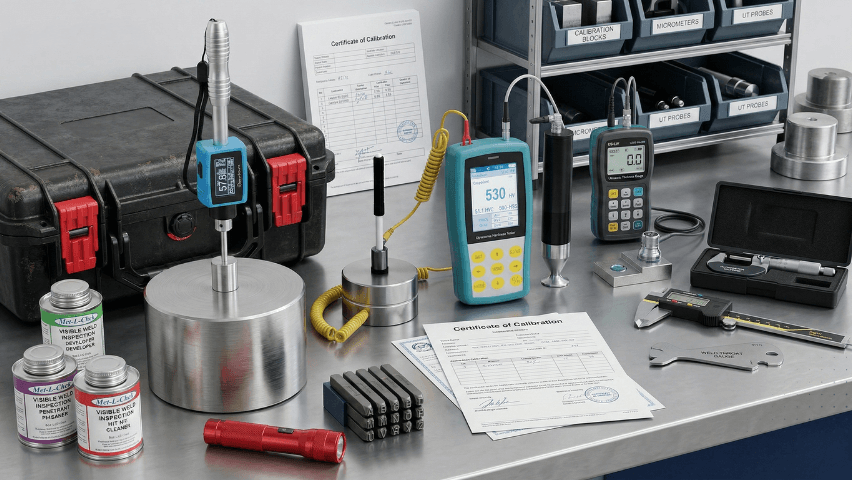
Portable hardness testing represents a fundamental segment of non-destructive evaluation for modern industrial components. Selecting a uci hardness tester allows for precise measurements using the Ultrasonic Contact Impedance method, often described as a modified Vickers approach. This technology remains a preferred choice for specialized applications where benchtop testers cannot reach.
Many professionals struggle to determine whether UCI or the traditional Leeb rebound principle fits their specific workflow. The physical characteristics and surface geometry of the test piece determine the correct technology selection. Portable UCI hardness tester options on Qualitest North America provide a way to evaluate these differences across various hardware configurations.
What UCI Hardness Testing Is Actually Built For
The implementation of a uci hardness tester addresses challenges found with heavy and immovable industrial assets. This method uses a diamond indenter on a vibrating rod to measure the shift in ultrasonic frequency when pressed against a surface. Specific advantages support a variety of field requirements:
- Immovable Assets: Large structures like pressure vessels, pipelines, and bridge beams require on-site evaluation.
- All-Direction Testing: Probes function horizontally, vertically, or inverted without requiring complex recalibration for gravity.
- Tight Spaces: Compact probe designs allow access to narrow zones, recessed areas, and interior diameters.
- Complex Geometry: High-resolution measurements become possible on irregular surfaces where rebound methods fail.
- Fast Digital Acquisition: Readings appear within seconds and transfer to internal memory for immediate documentation.
Quality control teams utilize this technology to maintain standards across diverse material types. The ability to test in confined spaces makes it a fundamental tool for high-value asset management.
UCI vs. Leeb: The Core Practical Difference
Testing methods generally fall into two categories: static (UCI) and dynamic (Leeb). Each principle serves a specific part mass and thickness profile.
UCI Hardness Testing
A Portable UCI hardness tester secures local measurements on thin-walled components and complex surface features. It excels on gear roots, flange edges, molds, and sheets. Because the indenter remains in contact with the material, the mass of the part does not influence the result. Small, lightweight components stay stable under the manual or motorized probe, providing a reliable Vickers-equivalent value. Surface preparation requirements remain higher for UCI, as the diamond indenter requires a smooth finish to provide an accurate frequency shift.
Leeb Hardness Testing
Leeb testing relies on the rebound principle, where an impact body strikes a surface and measures the velocity loss. This dynamic method requires the part to have significant mass and thickness to prevent vibrations from absorbing the impact energy. Thin walls or lightweight parts often yield false low readings with Leeb unless they are coupled to a massive base. Modern hardware often integrates both technologies into a single unit. These dual-mode systems provide the flexibility to switch between static ultrasonic and dynamic rebound methods depending on the part currently on the inspection table.
Start With the Part Geometry, Not the Method Name
Selection of a Portable Ultrasonic Hardness Tester should follow an audit of the specimens handled most frequently. The shape and accessibility of the measurement point often dictate the success of the inspection process.
Consider these central questions during the equipment selection phase:
- Is the part heavy, immovable, or integrated into a larger assembly?
- Does the component have a thin wall or a lightweight structure?
- Is the surface irregular, curved, or recessed?
- Is the measurement location on a flange edge, tooth root, or welded zone?
- Does the operator need to test in multiple orientations?
- Does the workflow require high-resolution local precision?
Geometry determines whether a rebound impact body can properly strike and return from a surface. Recessed areas and narrow grooves often prevent the use of Leeb devices, making UCI the necessary choice for those specific zones.
When a Portable UCI Hardness Tester Is the Better Fit
Specialized components frequently require the surgical precision of an ultrasonic probe. A Portable UCI hardness tester serves as the primary tool for several challenging scenarios:
- Thin-Wall Pipes: Maintaining accuracy on containers and pipes with wall thicknesses below 5mm remains difficult for rebound testers.
- Welded Zones: Measuring the heat-affected zone (HAZ) of a weld requires a localized measurement that stays within a narrow boundary.
- Gear Teeth: Surface-hardened teeth and gear roots feature geometries that interfere with dynamic impact bodies.
- Molds and Sheets: Thin metal sheets and polished molds require the low-force, non-destructive nature of the modified Vickers method.
- Turbine Rotors: Complex blades and rotor assemblies demand probes that can fit into tight curvatures and provide results in any orientation.
Using a Portable UCI hardness tester for these applications avoids the inaccuracies caused by part vibration or insufficient mass.
When Leeb or Dual-Mode Systems Make More Sense
Broad field conditions sometimes favor a multi-method approach. Some workflows benefit from having both technologies available in a single portable unit. Dual-mode systems, such as the UCI-4000 and UCI-4100 series, allow inspectors to utilize the speed of Leeb on heavy castings while switching to UCI for thinner sections of the same component.
Choosing a dual-mode system provides a necessary safety net for inspectors who encounter unknown materials in the field. This flexibility secures a higher level of method coverage, reducing the need to carry multiple separate instruments. Rebound testing remains faster for large-scale surveys on massive blocks, while UCI handles the precision work on edges and coatings.
Manual vs. Motorized Probe: A Secondary Decision That Matters
UCI systems offer two distinct probe types that influence the repeatability and precision of the data.
Manual Probe
The operator manually positions the probe and applies pressure until the internal spring triggers the measurement. This process takes approximately one to two seconds. Manual probes provide high flexibility for reaching difficult spots and are a standard choice for most field inspections.
Motorized Probe
An integrated motor applies the test force at a controlled rate, removing operator-influenced variables. These probes are a fundamental requirement when working with low test forces or when the highest level of precision is required. Motorized versions are often preferred for testing thin coatings or highly polished surfaces where a consistent landing and force application are paramount.
Decision Framework: Which Method Fits Your Test Conditions?
The procurement process can be simplified by aligning specific part characteristics with the following scenarios:
Choose a UCI hardness tester when…
- The part geometry is thin, irregular, or difficult to access.
- The measurement must occur on a localized point like a weld or a tooth root.
- The operator needs to measure in multiple directions without gravity compensation.
- The application involves high-value molds, sheets, or turbine blades.
Choose a Leeb-based or dual-mode approach when…
- The workflow involves a mix of heavy castings and lightweight components.
- Field conditions are unpredictable and require multiple testing methods.
- Large-scale surveys on massive parts take priority over small-item precision.
Choose a motorized UCI probe when…
- Precision at extremely low forces remains the primary goal.
- The lab requires controlled, automated force application for better repeatability.
Compatibility and Model Pathways
Selection of a Portable Ultrasonic Hardness Tester requires a clear understanding of probe and device compatibility. Some platforms support only manual ultrasonic probes, while others accommodate both manual and motorized versions. Specialized dual-mode models include the electronics necessary to process both ultrasonic frequency shifts and Leeb rebound velocities. Buyers must select a model based on the intended method plan rather than choosing an instrument and forcing it to fit a mismatched geometry.
Common Buying Mistakes
- Leeb Only for Thin Walls: Purchasing a rebound-only tester for thin pipes, which results in erratic and inaccurate data.
- Ignoring Surface Finish: Selecting a Portable UCI hardness tester for rough, as-cast surfaces without planning for the necessary surface grinding.
- Mismatched Force: Using a high-force probe on a thin coating, which penetrates the layer and measures the substrate.
- Ignoring Geometry Access: Buying a standard impact device for recessed gear roots where the body cannot physically fit.
- Single-Method Limitations: Selecting a single-method unit when the facility handles a wide variety of both heavy and light parts.
Why Buyers Compare UCI Hardness Tester Options on Qualitest North America
Qualitest provides a comprehensive family of NDT solutions, spanning manual, motorized, and dual-mode configurations. The selection logic presented by the organization helps buyers think in terms of part geometry and field conditions rather than simple laboratory metrics. This approach allows users to compare UCI hardness testing solutions on Qualitest North America to find the specific hardware that handles welded parts, thin walls, and irregular surfaces.
Explore portable ultrasonic hardness tester systems on Qualitest allows inspectors to request a quote for the specific manual or motorized system that secures reliable data for their most challenging geometries.
About the Author