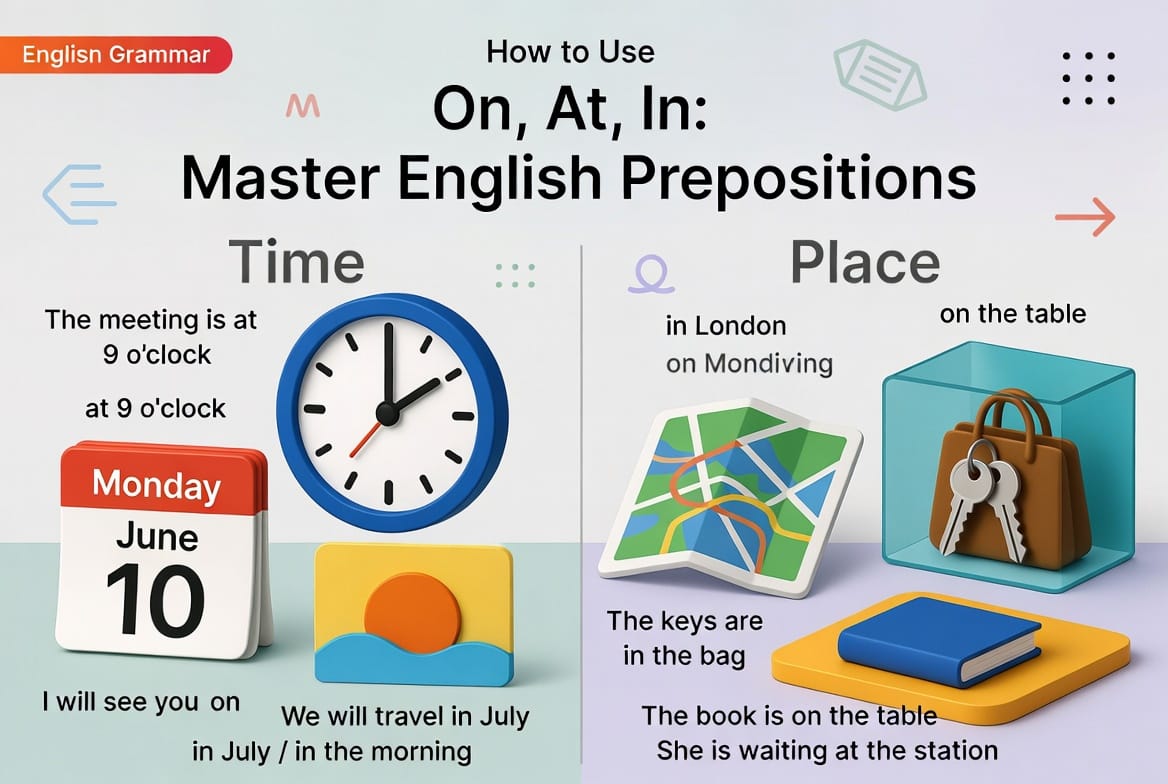
How to Use On, At, and In Correctly in English
The use of prepositions in the English language may be viewed as being rather challenging for learners. This is because the usage of these three simple words may completely change the meaning of the sentence.
The silver lining here is that all these words have some logic behind them. Usually, there are rules to their usage, which means that when you get a grasp of what they actually mean, the choice of prepositions becomes easy. In means broader or enclosed, on means connected or related to a certain date or surface, and at means pinpointed.
On, At, and In for Time: Simple Rules to Remember
On, at, and in can be used in different ways when discussing time. In refers to long periods, while on refers to days and dates. On the other hand, at refers to specific points in time. It is one of the most straightforward methods that can be used to eliminate errors.
If you want to stop guessing whether to use “on”, “at”, or “in”, you can learn how to use prepositions of place correctly by visiting: https://learn.kotoenglish.com/grammar/a1/prepositions-of-place/
Use “In” for Longer Time Periods
“In” works well when it is a matter of general times, not specific times. We employ “in” when talking about years, months, seasons, centuries, and times of day. This is how we say things like “I was born in 2012,” as years are extended periods of time. We also say “in July,” “in winter,” and “in the evening.”
Something similar happens when we talk about future events. When you say, “I’ll call you in ten minutes,” what you really mean is that you will make the phone call after ten minutes have passed. The in expression refers not to an exact moment on the clock, but to a small period preceding the event.
One easy trick to figure out whether your use of the preposition in is correct is to think about the nature of the time being referred to in the sentence. Months, years, seasons, and times of day can accommodate multiple units of time within themselves; “in” makes sense here.
Use “On” for Days and Dates
“On” is used when the time reference is more precise than months and seasons but not as accurate as time indicated by a watch. “On” is used when referring to days of the week, dates, and holidays. Your lesson takes place on Monday, your birthday is on June 10, and your family gathering is on Christmas Day.
Here comes another pitfall for second-language learners since their native language may differ in its grammar rules. English is not “in Monday” and “at Friday.” “On” is used with days.
Now it is time to notice one thing. On the one hand, we have “in the morning,” and, on the other, “on Monday morning.” Why do we need two different prepositions? Because “Monday morning” is more precise than “the morning.” It is similar to “on Friday evening” and “on the first day of school.”
Use “At” for Exact Times
The preposition “at” is used when there is an exact point in time. If the lesson begins at 9 o’clock, the time is definite. If the train departs at 6:45, there is a specific time according to the schedule. We use such expressions as “at noon,” “at midnight,” and “at sunrise.”
“At” can be compared with a pin on a line. This preposition does not refer to any period of time, but shows a particular moment. For that reason, “at 8 o’clock” sounds correct, while “in 8 o’clock” is incorrect.
There are some expressions with at that must be learned by heart because they do not fit into any strict rule. We say “at night,” “at the moment,” and “at the end of the lesson.”
On, At, and In for Place: Simple Rules to Remember
Place works in a similar way, although the meaning depends more on how we imagine the location. “In” often suggests being inside an area. “On” suggests contact with a surface or line. “At” points to a particular spot, venue, or meeting place.
Use “In” for Areas and Enclosed Spaces
The preposition “in” should be used when some object or person finds itself inside a physical space or area. Therefore, one says that “keys are in the bag,” while a “person is in the kitchen.” Just like that, you should use “in London,” “in Spain,” and “in Europe” when talking about being located somewhere inside some larger area.
In the case when the space does not have any boundaries or even any solid walls, “inside” would seem strange. Parks, gardens, cities, countries are open spaces, yet they still look like areas, thus, making the sentences like “The children are playing in the park” sound correct.
It might be rather difficult to understand whether one should say “in a plane” or “on a plane.” In most cases, you should use “in a plane,” “in a car,” and “in a taxi” since they remind you of small closed spaces. However, when you imagine a bus, train, or airplane as public transportation means, the correct preposition is “on.”
Use “On” for Surfaces, Screens, and Lines
The simplest use of “on” is that which is used when talking about surfaces. Your “book is on the table,” your “picture is on the wall” and your “name is on the page.” In all these cases, what you mention is touching or existing on the surface of something.
This concept has grown beyond physical things to technology and even the media. This is why we talk of something being on television or on the internet. The information is “on a platform” or “on some service provider” and thus “on” makes sense.
The other use of “on” is when we refer to streets, roads, rivers, or coasts. In English, these objects are considered lines, hence why we can use “on.” Some examples include saying that “the restaurant is on King Street” or that “there was heavy traffic on the road.”
Use “At” for Exact Points and Meeting Places
Use “at” when the place is conceived of as a point and not as an extensive space. For example, when one says “I’ll meet you at the bus stop”, it means that bus stop is considered a point for meeting. This is true about “at the door”, “at reception”, “at the entrance” and “at the station”.
“At” is frequently used after nouns that denote venue and address. You can meet someone “at the movies,” do your job “at the bank,” spend night “at the hotel” or live “at 25 Green Street.” In these cases, the exact location matters more than the idea of being inside a space.
Sometimes the distinction between “in” and “at” might be rather blurry. In the sentence “She is in the airport” the emphasis is placed on her presence inside the building. However, when one says “She is at the airport” there is no stress put upon whether she is inside or outside it.
Points to Sum Up
Rather than committing to memory an extensive list of exceptions and guidelines, the best way to learn how to use on, at, and in properly is by recognizing the patterns.
“In” can be used for extended periods and areas or locations that can be viewed as enclosures. “On” can be used for days, dates, surfaces, screens, and lines. “At” can be used for specific times, addresses, events, and precise locations.
As one encounters these prepositions in sentences, it becomes increasingly easier to remember how to use them. Practice writing sentences about one’s daily activities, family life, plans, and city.
About the Author