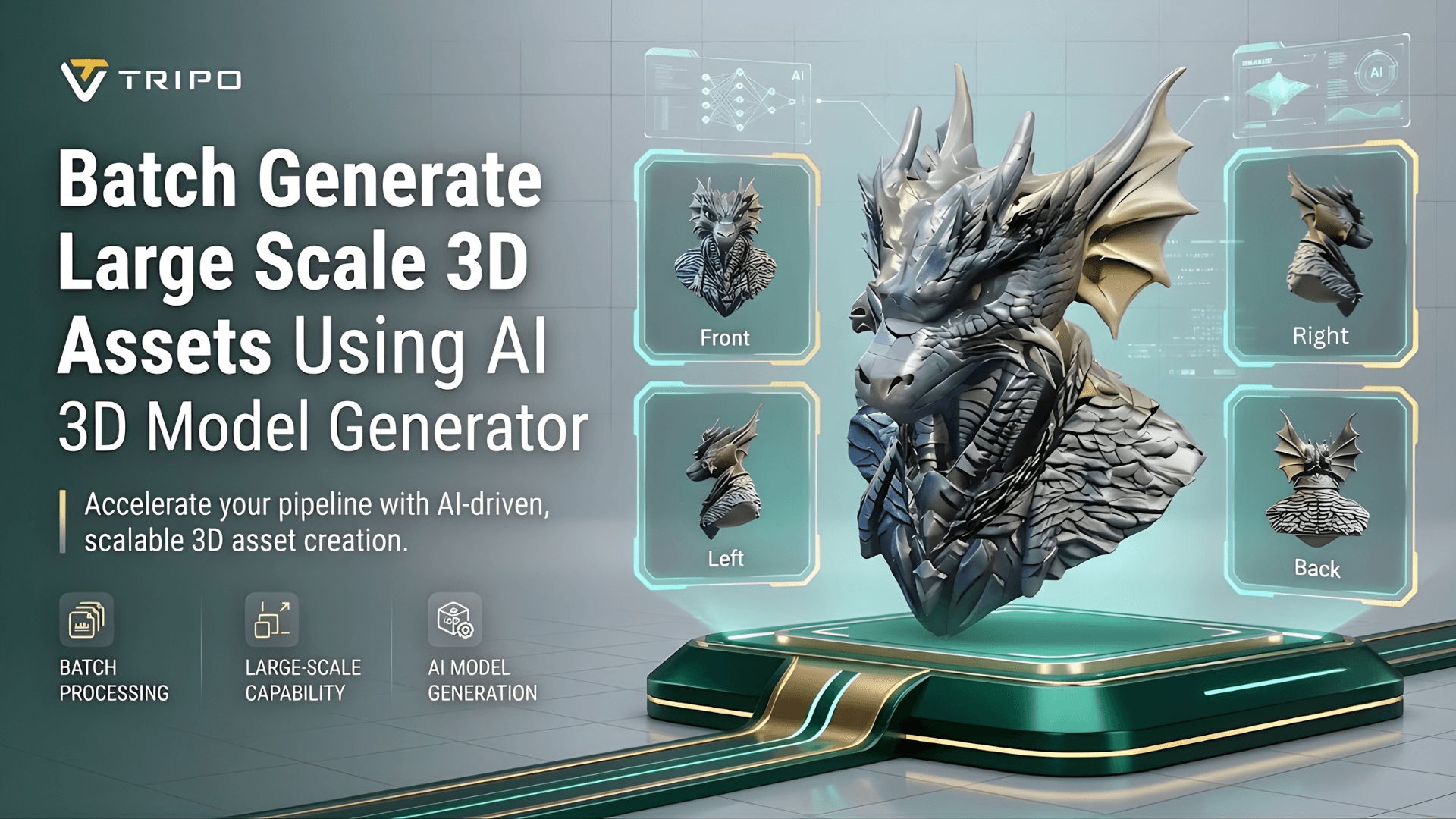
Pipelines need speed and consistency when it comes to dealing with large-scale 3D content production. Meeting industry demands becomes difficult with manual modeling workflows. The efficient generation of assets has changed because of AI-powered tools. Tripo 3D provides the ability to rapidly create prototype-ready 3D models from simple inputs. It is used in scalable workflows across the gaming, animation, and design industries. Batch generation also improves productivity by creating several assets simultaneously. This saves time, increases quality, and enables creative pipelines for professionals.
Understanding Batch Generation in AI 3D Modeling
Batch generation is the 3D modeling AI process of generating multiple assets with the same process. It allows for processing group inputs efficiently and generating consistent outputs. This approach saves on repetitive tasks and enhances the large-scale production pipelines. It helps maintain well-organized asset libraries for artists and developers. It also helps accelerate iterations in complex projects. Batch processing can improve consistency when managing large collections of 3D content across various applications. AI 3d model generator systems can help streamline these workflows by speeding up the output process, while not compromising the accuracy of the structures produced.
Why Large-Scale Asset Creation Requires Automation
The demand for large-scale asset creation continues to grow across the gaming, film, and simulation industries. Manual workflows can become less efficient when handling increasing demands for large-scale content creation. To maintain production speed and quality, automation becomes increasingly important. Tripo 3D supports scalable output, making repetitive modeling tasks easier. For creators, AI 3D model generator platforms can automate 3D model creation while improving consistency across assets. These systems enable fast iterations and reduce manual work. They also help teams manage deadlines in complex projects. If you work in a large production environment, automation can support more predictable results and better resource allocation depending on project requirements and settings.
How Tripo 3D Supports Batch Asset Generation
Tripo 3D provides a unified platform for scalable asset creation across different industries. It integrates AI modeling, texturing, and optimization within a single pipeline. The image to 3d workflows allow users to transform images or ideas into structured 3D models, improving consistency while reducing manual effort. Tripo 3D also supports consistent textures across multiple assets, enhancing visual consistency. Prototype-ready model outputs can be imported into game engines, design software, and other creative tools for additional refinement. This system reduces manual effort and supports creative workflows.
Steps to batch generate for large-scale 3D assets using an AI 3d model generator.
Step 1: Set up assets for batch creation
- First, you need to access Tripo3d and signup. Next, go to the “Model” tab present in the vertical left menu bar.
- Under the menu, click on the “HD Model”. You can generate multiple assets either through text prompts or image uploads.
- You can drag and drop files or upload them from a specific location using the “Upload” tab.
- If images are unavailable, click on the “Text to model” tab and describe the required objects.
Step 2: Configure settings for large-scale generation
- Under the “General settings” tab, switch on “AI complete” to automate the workflow. You can also enable texture and select “Texture Quality” options, including 2K, 4K, or 8K.
- You can also turn on “PBR” for accurate reflective properties.
- For better topology characteristics, select either “Quad” or “Triangle” topology.
- You can also set the custom polycount.
Later choose the model from the list, including v3.1 best quality, v3.0 fast and balanced, or v2.5 legacy. - If you are a member, then you can choose “Generate in Parts”, “8K Texture”, and “Privacy” options.
- Finally, click on “Generate Model” to begin generation.
Step 3: Review assets and export results
- Tripo 3D allows you to inspect generated assets in “Solid View”, “Cartoon Style”, “Sketch Style”, “Hologram Style”, and “Unlit” form. You can also use “Refine” from the bottom menu.
- You can also edit the “Environment Settings” and camera position through “Reset Camera”.
- If needed, you can 3D print the models or share them directly by clicking “3D Print”.
- In the end, click on the “Export” tab from the bottom menu. Next, choose the resolution, format, and file name, and click again on “Export” to save the design to your local device.
Key Benefits of Batch Generating 3D Assets
Batch generation delivers significant advantages for creators managing large-scale 3D asset production workflows across industries.
- Shortens cycles of creation and delivery pipelines for assets.
- Consistently provides uniform geometry and textures across all 3D assets created.
- This saves the time and effort of repetitive modeling tasks and streamlines the entire team workflow.
- Helps to scale from small projects to enterprise-level asset libraries.
- Enhances organization and management of large collections of 3D assets.
Essential Features Supporting Large-Scale Generation
Tripo 3D offers advanced tools that support professional 3D creation pipelines. Automated modeling helps generate structured meshes efficiently while reducing manual effort. It supports consistent topology and clean geometry for easier editing and animation. Scalable texturing allows detailed materials to be applied across multiple assets while preserving visual consistency. The platform supports flexible inputs, allowing users to generate 3D assets from images or text prompts through text to 3d model workflows. Production compatibility supports exports to widely used industry tools. Large-scale content production can be managed more efficiently. These features support stable and efficient asset generation.
Industries Benefiting from Batch 3D Asset Generation
Tripo 3D can be used across multiple industries to accelerate 3D content creation and improve asset quality. Gaming studios can create characters, environments, and props at a larger scale, while animation and film teams can benefit from quicker asset iteration and modeling workflows. Product design teams can convert concepts into visual 3D models for evaluation. Architectural teams can convert design plans into detailed spatial representations more efficiently. 3D printing workflows can utilize watertight models for prototype development and product visualization. Each sector can reduce production time while improving overall quality. It supports a variety of creative workflows and production pipelines.
Future Trends in Large-Scale AI Asset Production
Smart automation and adaptive AI systems represent the next stage of large-scale 3D production. Content pipelines will be more intelligent, with automated categorization of assets. Models may be improved automatically through quality enhancement tools. With optimized AI architectures, generation speed is continuously being enhanced. Technologies like Tripo 3D are expected to integrate more closely with broader creative ecosystems. Real-time collaboration will also optimize production processes. Highly specific asset generation will be possible thanks to AI-driven customization. Such advancements can simplify the creation process and support more efficient workflows for creators. The industry is heading towards more and more automated 3D content creation systems.
Conclusion
Batch generation is an approach to creating 3D content that supports efficient and scalable workflows. It decreases manual work and enhances consistency in large asset libraries. Tripo 3D is a platform that can help simplify the 3D creation process from input to export. It integrates modeling, texturing, and optimization features within a single workflow. Industries can benefit from reduced production time and improved quality management. Automation and AI-driven pipelines are expected to play an increasing role in future workflows. These developments allow creators to focus more on design rather than repetitive tasks. Efficient asset generation is becoming an important part of digital content creation across creative industries.
About the Author