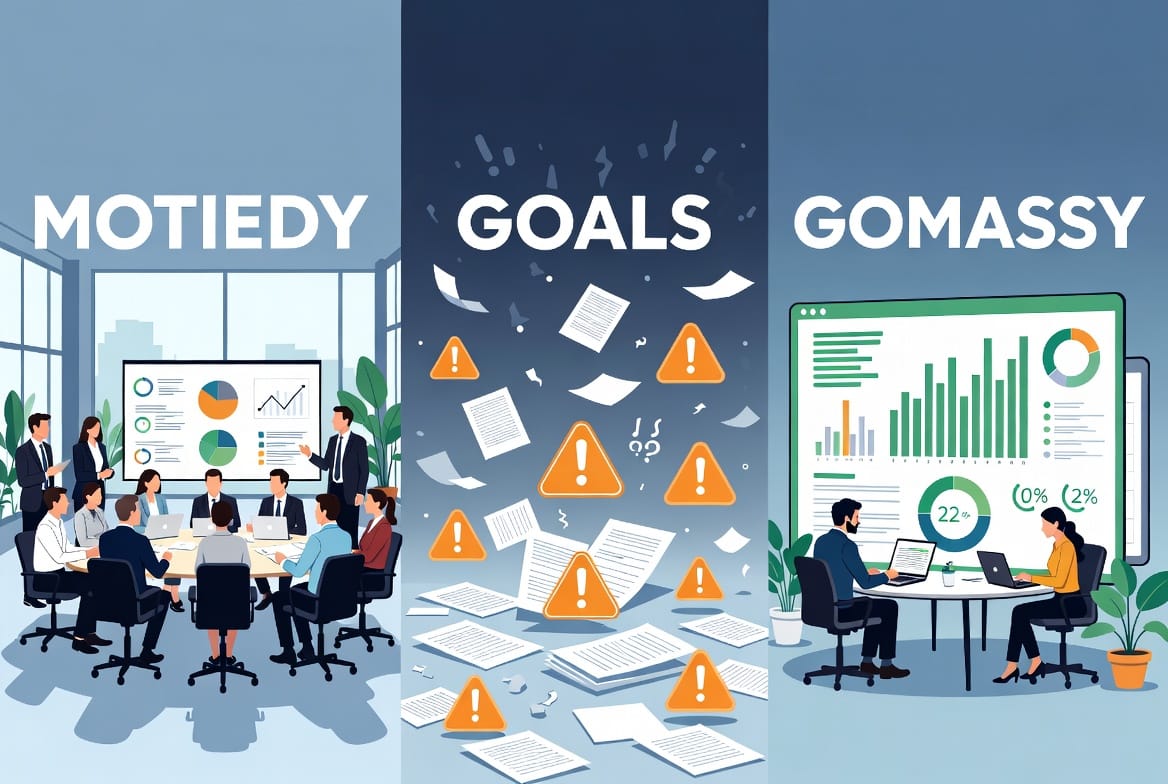
The goal-setting meeting always goes well. The objectives are clear, the team is aligned, and everyone leaves with a shared sense of what the quarter is for. Then the work starts — the urgent requests, the customer escalations, the sprint that’s already behind — and within three weeks, the goals that felt so clear in the planning session have quietly stopped shaping any decision being made.
It happens at companies of every size, in every industry, in every quarter where the goal-setting process ends at the document and never makes it to a system.
This article covers the tools and habits that keep goals alive from the first week of the quarter to the last.
Why Goals Fail Before the Quarter Ends
The research on this is unambiguous. According to a study of 330 organisations by OKRs Tool, 65% of teams admit their goals are not directly linked to company objectives. Nearly half of all weekly work has no connection to a stated quarterly goal. And the average business running a goal-setting programme sees completion rates of around 51% in the first cycle — meaning roughly half of what got committed to at the planning session doesn’t get done.
The failure mode is almost always the same. Goals are documented but not managed. There’s a difference between writing an objective and running one. Writing takes an afternoon. Running it requires visibility, ownership, and a weekly check-in that keeps the team honest about where things actually stand.
The Three Habits That Separate Teams That Hit Goals From Teams That Don’t
Businesses that consistently achieve their quarterly goals share three operational habits — and none of them require a new methodology or a two-day offsite to implement.
The first is weekly check-ins. Teams that review progress on their goals every week achieve 43% higher completion rates than those checking in quarterly. The check-in doesn’t need to be a meeting. A five-minute async update — what moved this week, what’s blocked, what needs to change — is enough to catch drift before it compounds into a missed quarter.
The second is explicit ownership. Every goal needs one named person accountable for it. Not a team, not a department — one person whose job it is to know whether the number is moving and what’s in the way. Shared ownership is, in practice, unowned.
The third is visibility. Goals that live in a planning doc nobody opens stop shaping decisions within two weeks. When objectives are visible in the tools the team uses every day — in Slack, in their project board, in the weekly dashboard — they stay present in the conversations and decisions that determine whether they get hit.
Where Goal Tracking Software Comes In
Building these three habits manually — weekly check-ins, explicit ownership, daily visibility — is possible but fragile. It works when the team is disciplined and the quarter is going well. It breaks down the moment things get busy, which is exactly when the habits matter most.
Goal tracking software makes the habits structural rather than discretionary. The check-in happens because the tool prompts it. Ownership is visible because it’s assigned in the system. Progress is visible because the dashboard updates automatically rather than waiting for someone to remember to compile it.
The category of software built specifically around this problem is OKR software — platforms designed from the ground up to run the goal-setting cycle rather than bolt it onto a project management tool.
Platforms like OKRs Tool, Perdoo, and Tability each approach this differently.
- OKRs Tool is built for growing businesses between 50 and 200 people, with weekly nudges, an AI Goal Assistant, flat-rate pricing, and an adoption guarantee — if the team doesn’t reach 60% adoption in 30 days, the refund is automatic.
- Perdoo combines OKR and KPI tracking in a single view, making it particularly useful for businesses that need to manage strategic goals and operational metrics together.
- Tability takes a lighter approach, focused on connecting weekly work to outcomes rather than building a full goal management infrastructure — a strong fit for smaller teams or product-focused organisations where the primary need is outcome visibility rather than a complete OKR cycle.
All three share the same underlying logic: the goal lives in a system the team touches every week, not a document they visit twice a quarter.
Getting Started Without Overcomplicating It
The most common mistake when a business decides to take goal-setting seriously is trying to build the whole system in the first cycle. Company OKRs, team OKRs, individual OKRs, scoring frameworks, cascading hierarchies — all at once, in the first quarter.
That approach produces a planning process that takes longer than the goals it generates are worth, a team that associates goal-setting with bureaucracy, and a second cycle with lower engagement than the first.
Start with one level. Three or four company-level goals for the quarter. Two or three measurable outcomes per goal. One named owner per outcome. A weekly update that takes five minutes. Run that for a full quarter before adding any complexity.
The framework is simple. The discipline of running it weekly is where the results get built — and the right tool makes that discipline structural rather than aspirational.
Disclaimer: This article is for informational purposes only. Results may vary depending on your team and circumstances. Mentions of specific tools are for illustration and do not constitute endorsements. The author is not responsible for any outcomes resulting from the use of this information.
Explore More
- Free ATS Resume Checker Online: Why Job Seekers Need One Before Applying
- What Makes a Modern House Plan Worth Buying?
About the Author